 Sudden Valley
 Building New in Barkley Means Getting the Windows Right the First Time
When you're building new in the Barkley area near Sudden Valley, the windows going into that framing package are one of the few components you genuinely get one shot at doing correctly. On a replacement job, a contractor is working around whatever the original builder did — good or bad. On new construction, there's no prior work to blame and nothing hidden yet. The flashing, the sill pans, the sealant lines, and the fastening schedule all happen once, in the open, before siding or trim closes it up. If it's done right, you likely won't think about it again for decades. If it's done wrong, the problem is buried behind finished walls and doesn't show up until there's already damage.
Whatcom County's climate doesn't give new construction any grace period either. Salt-laden air off the water, long stretches of driving rain, and a moss season that can run half the year all start working on a building envelope the moment it's exposed. A window opening that sits unsealed or under-flashed for even a few weeks during framing can take on moisture that stays trapped once the wall is closed in. New-construction windows in this region need to be installed with that reality in mind from day one, not treated as a generic install that happens to be in a wetter climate.
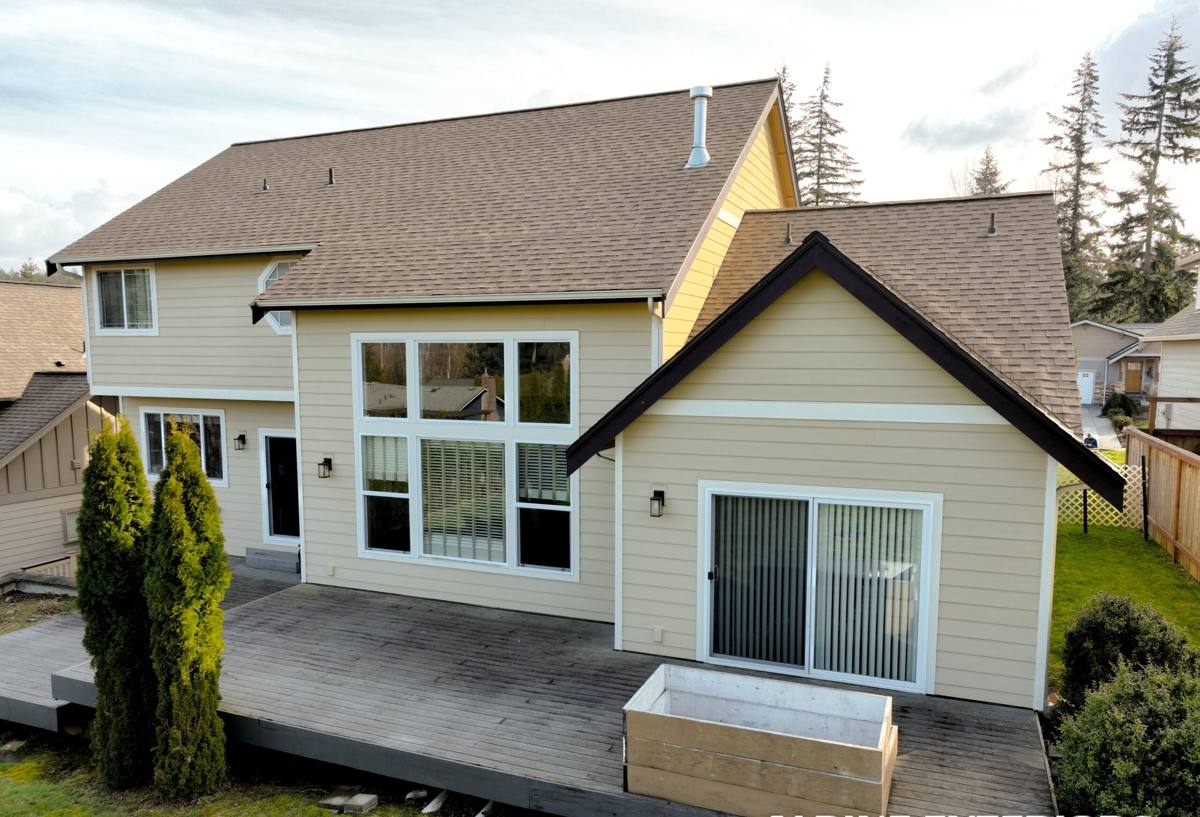
What Local Homes Actually Need From New-Construction Windows
New builds in and around Sudden Valley face a few specific conditions that should shape how windows are specified and installed:
- Wind-driven rain resistance: Rain here rarely falls straight down. Driving rain pushes water sideways into any gap in the flashing or sealant, so the water management layer matters as much as the window unit itself.
- Salt air exposure: Airborne salt accelerates corrosion on fasteners, hardware, and lower-grade cladding over time. Material choice and fastener spec matter more here than in a dry inland climate.
- Moss and organic growth: A long damp season means moss and algae find a foothold anywhere water sits or drainage is poor — including on sills, trim, and the base of window openings if they're not detailed to shed water.
- UV and thermal cycling: Even in a cloudy climate, sealants and gaskets still degrade from UV and temperature swings over the years. Quality of materials at install time affects how long the seal actually lasts.
None of these conditions are unique to Barkley specifically, but they're the baseline every new-construction window in this part of Whatcom County has to be built to handle.
What a Correct New-Construction Window Installation Involves
New-construction windows (as opposed to pocket-style replacement units) have a nailing fin around the perimeter that gets integrated directly into the wall's water-resistive barrier before siding goes on. That integration is where most long-term problems either get prevented or created. A correct install, in order, generally includes:
- Confirming the rough opening is square, level, and sized correctly before the window ever goes in — a slightly out-of-square opening now becomes a lifetime of stress on the frame and seals.
- Installing a sloped sill pan so any water that does get past the exterior seal drains back out rather than sitting against the framing.
- Applying flashing tape or membrane at the sill and jambs in the correct shingle-lap sequence — sill first, then jambs, then head — so water is always directed down and out, never trapped behind a layer above it.
- Setting the window, checking it's plumb and square, and fastening through the nailing fin per the manufacturer's schedule (skipping or under-driving fasteners is a common shortcut that shows up later as air and water infiltration).
- Integrating the head flashing over the window and under the housewrap above it, maintaining the correct water shingle direction all the way up the wall.
- Sealing and insulating the interior gap between the frame and rough opening without over-packing it, which can bow the frame and cause operational issues.
- Finishing exterior trim and sealant joints in a way that sheds water rather than collecting it — a detail that also determines whether moss gets a place to start.
Every one of those steps is inspectable while it's happening and invisible once the wall is closed. That's exactly why the crew doing it, and their habits, matter more on new construction than almost any other exterior trade.
New-Construction Windows vs. Replacement Windows: Why the Distinction Matters
It's worth being clear about what "new-construction" actually means, because it changes the installation approach entirely.
| Factor | New-Construction Window | Replacement (Pocket) Window |
|---|---|---|
| Installation method | Nailing fin fastened to sheathing, integrated with WRB and flashing | Inserted into existing frame, minimal fastening to structure |
| Access to framing | Full access to rough opening and sheathing | Existing frame stays in place, limited access |
| Flashing control | Full control over sill pan, jamb, and head flashing sequence | Relies heavily on condition of existing flashing |
| Best suited for | New builds, additions, full wall re-sides down to sheathing | Existing openings where wall isn't being opened up |
| Long-term risk if done poorly | Water intrusion behind siding, hidden framing rot | Air/water leaks at the existing frame interface |
Because Barkley-area new construction gives us access to bare sheathing before siding goes on, there's no excuse for cutting corners on flashing sequence. It's the one point in the building's life where every layer is visible and correctable before it's covered.
Choosing Window Materials for a Whatcom County Build
Vinyl, fiberglass, and wood-clad windows all show up on new builds in this region, and each comes with real trade-offs rather than a clear "best" answer.
| Material | Moisture/Salt-Air Behavior | Maintenance | Typical Fit |
|---|---|---|---|
| Vinyl | Won't corrode or rot; performs well in salt air and rain | Low — occasional cleaning | Budget-conscious new builds, rental or spec homes |
| Fiberglass | Very stable in moisture and temperature swings, resists warping | Low | Higher-end new construction, larger openings |
| Wood-clad | Exterior cladding protects wood, but any breach in the seal exposes wood to rot risk | Higher — seal integrity must be maintained over time | Homeowners who want a wood interior look and are willing to maintain it |
We'll walk through the trade-offs honestly for your specific build rather than pushing one line — the right call depends on budget, the home's exposure to weather, and how much ongoing maintenance you want to take on.
Our Process on Barkley New-Construction Projects
Because we work regularly in Sudden Valley and the surrounding Barkley area, our process on a new build isn't something we're improvising per job:
- Rough opening check: We verify openings against the window schedule and framing before anything is installed, catching sizing issues while they're still cheap to fix.
- Sill pan and flashing: We install sloped sill pans and a full shingle-lap flashing sequence on every opening, regardless of window price point — this step doesn't get skipped to save time.
- Window set and fastening: Units are set plumb, square, and fastened to the manufacturer's schedule so the warranty stays intact and the frame performs as designed.
- Head flashing and WRB tie-in: We tie the head flashing into the water-resistive barrier correctly so water sheds down and out, not behind the wall assembly.
- Interior and exterior sealing: Interior gaps are insulated without over-packing; exterior joints are sealed with materials rated for sustained wet exposure.
- Final walk-through: Every opening gets checked for operation, seal, and squareness before we consider the job finished — not just a visual pass from the outside.
Common Mistakes We See on New Builds (and Build Our Process to Avoid)
Most window problems on new construction don't come from a bad window — they come from a rushed or out-of-sequence install. The mistakes we see most often on new builds in wetter climates include skipping the sill pan entirely and relying on sealant alone, flashing the jambs before the sill (which reverses the water shingle direction and traps water instead of shedding it), under-fastening the nailing fin to save time, and packing spray foam too tightly around the frame, which can bow it and cause the sash to bind. Each of these is invisible the day the job is finished and only becomes obvious years later as a leak, a soft spot in the wall, or a window that won't close evenly anymore.
Why a Crew That Already Works Barkley Matters
A crew that's done new-construction window work around Sudden Valley and the Barkley area already understands the exposure conditions specific to this part of Whatcom County — how much wind-driven rain a given elevation typically takes, how long moss season really runs, and what fastener and sealant specs actually hold up here versus what a manufacturer's generic install guide assumes for a drier climate. That's not a guess dressed up as local knowledge — it's the difference between following a spec sheet and understanding why the spec sheet says what it does for this specific region.
After Move-In: A Simple Owner's Checklist
Once your new-construction windows are in and the home is finished, a few basic habits go a long way toward protecting that install for the long haul:
- Walk the exterior after the first heavy rain of the season and check that sills and trim are draining, not holding standing water.
- Look for any moss or algae starting at window sills or trim early in the wet season — it's easier to clear than to let it establish.
- Check interior sills for condensation buildup in colder months, which can signal a ventilation issue rather than a window defect.
- Have exterior caulk joints inspected every few years — sealant is a wear item, not a permanent seal, even when installed correctly.
- Keep windows operating smoothly by cleaning tracks and hardware periodically, especially on units near salt-air exposure.
If you're planning a new build in the Barkley or Sudden Valley area and want windows installed by a crew that treats the flashing and sealing sequence as seriously as the window itself, we're happy to walk your plans and give you a straightforward, no-pressure estimate.