 Sudden Valley
 Siding in Geneva: A Different Set of Problems Than a Typical Suburb
Geneva sits at the north end of Lake Whatcom, close enough to Bellingham Bay and the Salish Sea to catch marine air off the water, and close enough to the lake and the surrounding tree cover to spend a good part of the year sitting in shade and moisture. That combination — salt-tinged air moving in from the Sound, driving rain off the water, and a long stretch of the calendar where surfaces just don't dry out — is harder on a home's exterior than most homeowners realize until they're standing in front of siding that's cupping, staining, or soft at the bottom edge.
We work on homes throughout Sudden Valley and the surrounding Lake Whatcom communities, and Geneva properties tend to share a few things in common: older tree canopy that keeps north- and east-facing walls in shadow much of the year, proximity to the lake that keeps ambient humidity higher than a few miles inland, and homes built across a wide range of eras and budgets, meaning the siding on any given house could be anything from old cedar to vinyl to something already failing. There's no single "typical" Geneva house, but there is a typical set of weather conditions working against whatever's on the wall.
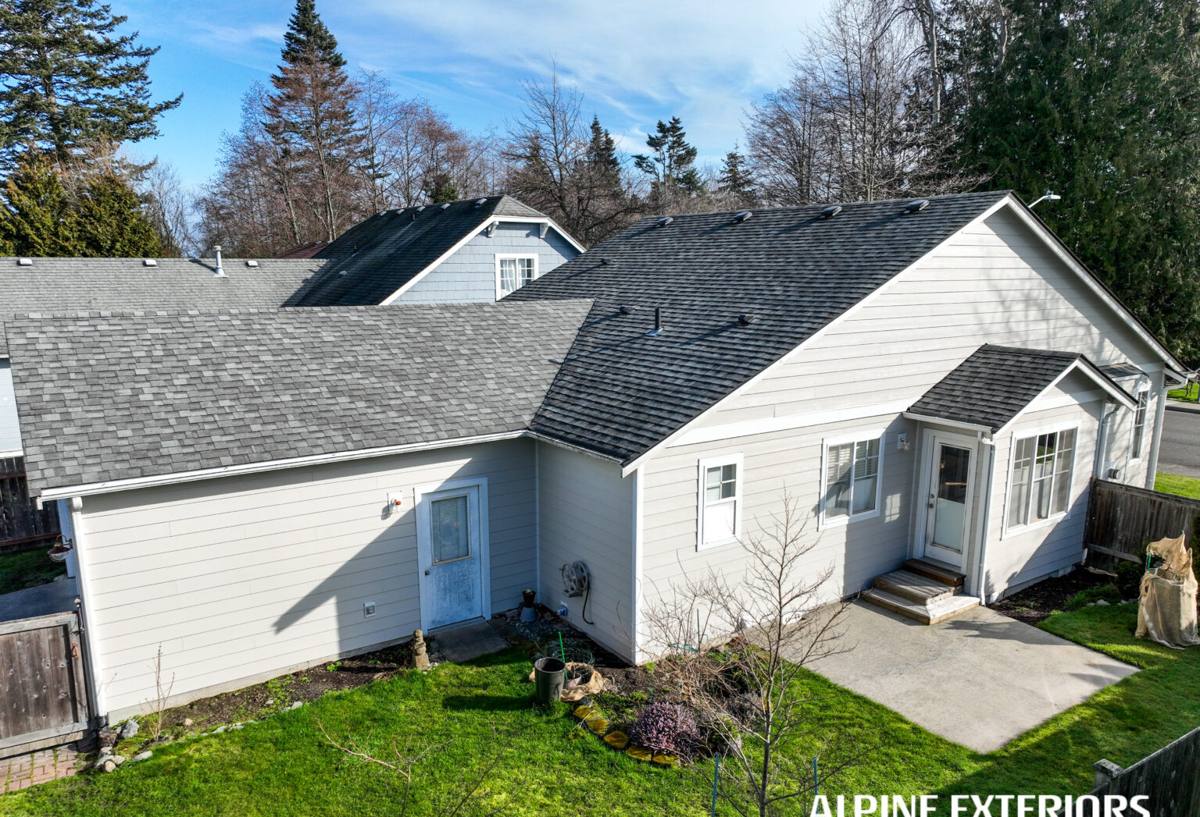
What the Climate Actually Does to Exterior Materials
Salt Air
Whatcom County isn't a beachfront environment the way the outer coast is, but Geneva's position near Bellingham Bay means airborne salt does reach homes here, especially on days with onshore wind. Over years, salt-laden moisture accelerates corrosion on fasteners, trim flashing, and any metal components in the building envelope, and it speeds up the breakdown of finishes that aren't formulated to resist it.
Driving Rain
This part of Washington doesn't just get a lot of rain — it gets a lot of wind-driven rain, which behaves differently than a straight-down shower. Driving rain gets pushed sideways into lap joints, under trim, and into any seam or gap in the siding system that wouldn't be a problem in a calmer climate. Siding that isn't installed with the right laps, flashing, and clearances will eventually let that water behind the cladding, where it does the real damage.
Moss Season
Because so much of Geneva sits under tree cover near the lake, surfaces that don't get direct sun for long stretches stay damp far longer after a rain event than an open, sunny lot would. That's what drives the long moss and algae season on roofs, decks, and siding here — organic growth needs moisture and shade, and this area supplies both for much of the year. Moss and algae aren't just cosmetic; they hold moisture against the surface underneath them, which shortens the life of paint, caulk, and the substrate itself.
Why the Siding Material You Choose Matters More Here
In a drier, sunnier climate, a wider range of siding products can perform acceptably for a long time because the conditions aren't stress-testing every seam and finish year-round. In Geneva's climate, the gap between a product that's genuinely engineered for sustained moisture exposure and one that merely tolerates occasional rain shows up faster — often within the first decade.
This is the core reason we standardized on James Hardie fiber cement siding and stopped installing several other common products. It isn't a marketing position — it's a conclusion we came to after years of exterior work in exactly this kind of marine, tree-shaded environment.
What We Don't Install, and Why
- Vinyl siding: Lightweight and inexpensive, but it expands and contracts significantly with temperature swings, can warp or crack in wind-driven conditions, and its seams and laps are more forgiving of moisture intrusion than fiber cement's. It also can't be painted a dark color in this region without heat-related warping risk.
- LP SmartSide and other engineered wood products: These use a wood-strand substrate that performs well when the coating stays intact, but any breach — a nail pop, a poorly sealed cut edge, a spot where caulk fails — lets moisture into a wood-based core, and in a climate with this much sustained dampness, that's a real long-term risk.
- Cemplank and Allura: Both are fiber cement competitors to Hardie, and reasonable products in general. Our decision to standardize on one manufacturer comes down to consistency of factory finish quality, warranty structure, and product-line engineering for our specific climate zone — not a claim that every alternative is unusable.
- Primed spruce and cedar: Real wood siding, well maintained, can look excellent, but "well maintained" in this climate means active, recurring maintenance — recoating, caulking, and moisture monitoring on a schedule most homeowners don't want to keep up with for decades.
James Hardie fiber cement is non-combustible, dimensionally stable, and its ColorPlus factory finish is baked on and warrantied against fading and peeling in a way field-applied paint isn't. The HZ5 product line in particular is engineered for cold, wet, high-moisture climates like ours — it's not a generic siding board, it's a version of the product built for this weather.
Comparing Common Siding Options for This Climate
| Material | Moisture Tolerance Here | Maintenance Burden | Typical Lifespan Locally |
|---|---|---|---|
| James Hardie fiber cement | High — engineered for wet marine climates | Low — factory finish, occasional wash | 30+ years with proper install |
| Vinyl | Moderate — seams vulnerable to driving rain | Low, but limited repair options | 15-25 years |
| Engineered wood (LP SmartSide, etc.) | Moderate — depends on coating integrity | Moderate — watch for edge/nail failures | 15-30 years, variable |
| Cedar / primed spruce | Low without diligent upkeep | High — recoating, caulking cycles | Highly variable, often under 20 years |
These are general patterns, not guarantees — installation quality affects every one of these numbers more than the material spec sheet does. But the pattern holds across the homes we've worked on in this area: the products least dependent on perfect, ongoing maintenance are the ones that hold up best in Geneva's specific combination of shade, moisture, and salt air.
It's Not Just Siding — The Whole Exterior Works Together
We handle siding, roofing, windows, and decks, and in a climate like this, treating those as separate problems is a mistake. Water that gets past a roof edge shows up as a stain on the siding below it. A deck built against the house without proper flashing sends moisture straight into the wall assembly behind it. Windows with failed seals let driving rain track down into the siding and trim around them. When we look at a Geneva property, we're looking at how water moves across the whole exterior, not just whether the siding boards themselves look fine.
That matters especially with moss and algae. If moss is thriving on the roof, the same conditions producing it — shade, sustained moisture, poor airflow — are working on the siding and deck too. Addressing one without looking at the others usually means the problem resurfaces somewhere close by within a few years.
What to Look For on Your Own Exterior
- Soft or spongy siding, especially near the bottom courses or around window and door trim
- Paint that's peeling, bubbling, or chalking, particularly on shaded north- or east-facing walls
- Visible moss or dark streaking on siding, fascia, or roof edges that returns shortly after cleaning
- Nail pops, warped boards, or gaps opening up at seams and corners
- Musty smell or visible staining on interior walls that back up to exterior siding
- Caulking that's cracked, shrunk, or pulled away from trim and window edges
Any one of these on its own might just need routine attention. Several of them together, especially on the same wall, usually means moisture has been getting behind the siding for a while.
Why a Local Crew Matters for a Property Like Yours
Installation quality is what separates siding that lasts thirty years from siding that fails in ten, and installation quality depends on understanding the specific conditions of the site — how much shade a wall gets, which direction the prevailing driving rain comes from, whether the lot's tree cover changes the drying pattern, how close the property sits to the lake or the bay. A crew that works across Whatcom County and knows Lake Whatcom's microclimates builds in the flashing, clearances, and fastening details that matter here, rather than applying a generic install spec written for a drier region.
It also matters for follow-up. A local contractor is the one who answers the phone in year eight when a question comes up about warranty coverage or a spot that needs a look, not a crew that moved on to the next region over.
What to Expect From an Estimate and Project
- An on-site walkthrough of the siding, trim, roofline, and any adjacent decks or windows, looking at how water is currently moving across the exterior
- An honest read on what's actually failing versus what's cosmetic, with photos where useful
- A written estimate for James Hardie fiber cement siding scoped to your home, including the specific HZ product line suited to this climate
- A clear installation plan covering flashing, clearances, and fastening details appropriate to a wet, shaded, marine-influenced site
If you're noticing moisture issues, moss that won't stay gone, or siding that's simply reached the end of its useful life, we're happy to take a look and give you a straight answer about what's going on and what it would take to fix it right. A free, no-pressure estimate is a good first step — you can request one using the form below.