 Sudden Valley
 Homeowners in Sudden Valley ask us about LP SmartSide more often than almost any other product, usually because a neighbor has it, a builder recommended it, or it showed up as the "budget-friendly" option during a remodel quote. It's a fair question, and it deserves a straight answer. We don't install LP SmartSide on the homes we work on, and this page explains exactly why — not to trash the product, but to be upfront about the trade-offs we've seen and why we made James Hardie fiber cement our standard instead.
What LP SmartSide Actually Is
LP SmartSide is an engineered wood siding product. At its core, it's made from strand-based wood fibers bonded with resin and wax under heat and pressure, then coated with a resin-saturated overlay and factory primer. It's a genuine improvement over the old-school OSB siding products that gave engineered wood a bad name in the 1990s. LP has spent real engineering effort on making the product more moisture-resistant than its predecessors, and for a lot of markets — especially drier climates — it performs reasonably well.
It comes in lap siding, panel siding, and trim configurations, and it's priced to compete directly with vinyl and fiber cement as a mid-range option. That price point is exactly why it comes up so often in conversations with homeowners here.
Where It Genuinely Gets Things Right
- Lighter than fiber cement, which can mean faster installation and less strain on carpenters
- Easier to cut and work with than cement-based products — no silica dust concerns during cutting
- Holds paint reasonably well when the factory finish is properly maintained
- Lower material cost than premium fiber cement in most markets
- Impact resistance is decent — better than vinyl in that regard
We're not going to pretend those points don't matter to a homeowner working within a budget. They do. But Sudden Valley isn't a dry climate market, and that changes the calculation.
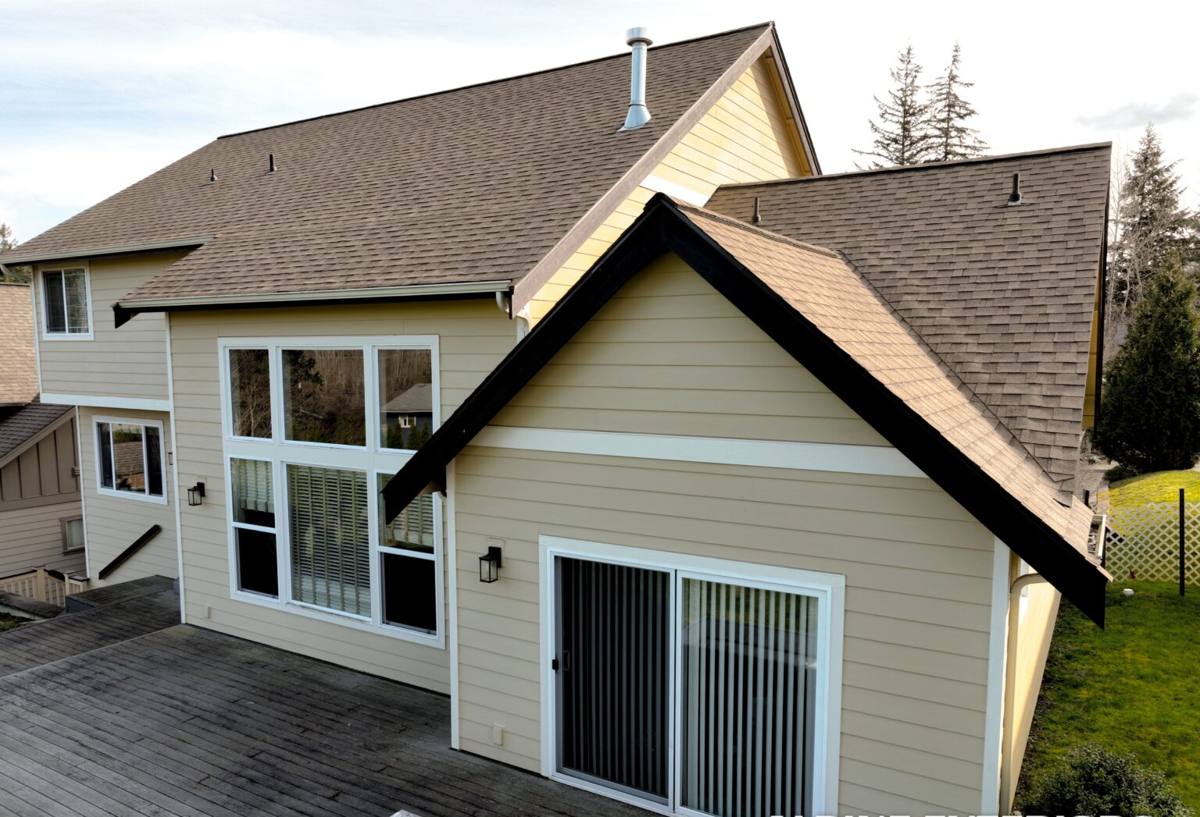
The Core Issue: It's Still Wood
No matter how it's engineered, LP SmartSide is a wood-based product. Wood strand composites are treated with zinc borate and other additives to resist fungal decay and insects, and the factory overlay helps shed water. But the fundamental material is organic, and organic material swells, absorbs moisture, and eventually breaks down when it stays wet long enough. That's not a defect — it's physics. The question for any homeowner is whether their site conditions keep the product dry enough, often enough, for that engineering to hold up over 30-plus years.
In Whatcom County, that's a harder bar to clear than in most of the country. Sudden Valley sits close to Lake Whatcom, wrapped in fir and cedar forest, with the kind of shade cover and standing moisture that keeps siding wet longer after every rain. Add the driving rain that comes off Bellingham Bay and the Salish Sea during winter storms, plus the salt-tinged marine air along this stretch of coastline, and you've got a climate that's tough on any wood-based exterior product — even a well-engineered one.
Where the Failures Actually Happen
When LP SmartSide problems show up, they're almost never random. They cluster at specific weak points:
- Cut edges and end cuts — every field cut exposes raw substrate unless it's sealed immediately and correctly, every time, on every board
- Butt joints — where two boards meet is where water wants to sit and wick in
- Bottom edges near grade — splash-back from landscaping beds or hardscape holds moisture against the lowest courses
- Areas under gutters or downspouts with poor flashing — concentrated water flow finds any gap in the seal
- North-facing and shaded walls — the sides of a house that never fully dry out between rain events
None of those are unique to LP — they're weak points for any wood siding. The difference is that LP SmartSide's whole value proposition rests on factory engineering solving problems that field installation can still undo. If a crew doesn't caulk and prime every single cut edge, or if flashing details get rushed, the product's moisture resistance stops meaning much at that spot.
Installation Sensitivity: The Real Deal-Breaker for Us
This is the heart of why we don't install it. LP SmartSide's warranty and long-term performance depend heavily on installers following the manufacturer's application instructions to the letter — specific fastener types and placement, minimum clearances from grade and roofing, sealing every cut end with approved primer before the board goes up, correct overlap at joints, and proper flashing at every penetration and transition.
That's not a knock on the product's design. It's an honest description of how much rides on field execution. We've built our business around fiber cement specifically because it gives us a wider margin for the kind of real-world install conditions — weather windows, crew turnover, tight schedules — that make "perfect execution on every single board" a hard standard to guarantee on every job, every time. With Hardie's fiber cement, the material itself is far more forgiving of minor installation variance because it isn't organic and doesn't rely on an intact factory seal to resist rot.
Maintenance Burden Over Time
LP SmartSide needs the homeowner to stay on top of a few things that fiber cement doesn't demand:
- Repainting or recoating on a cycle recommended by the manufacturer, not "whenever it looks faded"
- Prompt caulk repair anywhere caulk cracks, shrinks, or pulls away
- Regular inspection at joints, corners, and the bottom course for swelling or soft spots
- Keeping vegetation, mulch, and sprinkler spray away from the siding face
- Moss and algae cleanup on shaded elevations before it holds moisture against the surface
That last point matters more here than almost anywhere else we work. Whatcom County's long moss season — stretching from fall through spring most years — means shaded, north-facing walls stay damp for extended stretches. On a wood-based product, that's exactly the condition that stresses the material and its factory seal over time.
How LP SmartSide Compares to James Hardie Fiber Cement
| Factor | LP SmartSide | James Hardie Fiber Cement |
|---|---|---|
| Base material | Engineered wood strand | Cement, sand, cellulose fiber |
| Moisture behavior | Resistant if seal stays intact | Non-organic, does not rot |
| Combustibility | Combustible (wood-based) | Non-combustible |
| Installation sensitivity | High — depends on sealing every cut | Lower — more forgiving of field variance |
| Factory finish | Primed, needs top-coat paint | ColorPlus baked-on finish available |
| Typical material cost | Lower | Moderate to higher |
| Manufacturer warranty structure | Limited, installation-dependent | Long-term, transferable options |
| Performance in wet, shaded coastal climates | Requires diligent maintenance | Engineered HZ5 line built for this region |
The cost gap is real and we won't pretend otherwise. But when a homeowner is planning to stay in a Sudden Valley home for 15, 20, or 30 years, the cost of siding isn't just the invoice — it's the maintenance calls, the recaulking, the repainting, and the risk of a callback on a cut edge nobody caught. We'd rather quote a product once and have it perform without that ongoing list.
Why We Standardized on James Hardie
We made the decision years ago to install exclusively James Hardie fiber cement, and it wasn't a marketing choice — it was a response to what actually holds up on homes in this specific corner of Washington. Hardie's HZ5 product line is engineered specifically for climates with heavy moisture exposure, which describes Sudden Valley about as well as anywhere in the state. It's non-combustible, which matters given the wildfire smoke seasons the Pacific Northwest has seen in recent years. The ColorPlus factory finish means the color coat is baked on under controlled conditions rather than relying on field-applied paint holding up against driving rain and salt air. And because the material itself isn't organic, cut edges and joints don't carry the same rot risk that keeps wood-based products dependent on perfect field sealing.
None of that makes Hardie maintenance-free — no siding is. It still needs proper caulking, periodic inspection, and correct installation. But the margin for error is wider, and the material doesn't punish a missed detail the way an organic product can.
What This Means for Your Project
If you're comparing quotes and one includes LP SmartSide at a lower number, that's not necessarily a bad-faith quote — it's a legitimate product with a legitimate price point. Our position is simply that after years of installing exterior products in this climate, we don't think it's the right long-term fit for homes exposed to Whatcom County's rain, shade, and moss conditions, and we'd rather tell you that directly than install something we're not fully confident in.
Here's a short checklist if you're weighing wood-based engineered siding against fiber cement for a home in this area:
- How many hours of direct sun do the shaded or north-facing walls get in winter?
- Is the home close to standing water, heavy tree cover, or moss-prone landscaping?
- Are you comfortable with a repainting and recaulking schedule over the life of the siding?
- Does the warranty hold up if a future owner doesn't maintain the same schedule?
- Is fire resistance a factor given regional wildfire smoke seasons?
If those answers point toward "I want to install this once and not think about it for decades," fiber cement is almost always going to be the better fit for a Sudden Valley property.
We're happy to walk through your specific home, your exposure, and your budget honestly — including telling you if a lower-cost option would genuinely serve you fine in your situation. Reach out for a free, no-pressure estimate and we'll give you our real assessment, not just a sales pitch.