 Sudden Valley
 Exterior Work Built for Sunnyland's Housing Stock
Sunnyland is one of the older, more established neighborhoods in the Bellingham area, with a mix of mid-century homes, post-war bungalows, and newer infill construction tucked under mature tree canopy. That combination — older siding and trim details next to heavy shade from big conifers and maples — creates a specific set of exterior problems that show up again and again when we get called out to look at a home in this part of Whatcom County. Shade keeps siding damp longer after every rain. Root systems and drainage patterns from decades-old landscaping can push water toward foundations in ways the original builder never planned for. And a lot of homes in this area are still wearing their original siding, sometimes multiple repaints deep, well past the point where paint alone is doing any real protective work.
We work throughout Sudden Valley and the greater Whatcom County area, and Sunnyland gets a fair amount of our attention simply because of how much of the housing stock here is reaching the age where siding, roofing, and windows start failing together instead of one at a time.
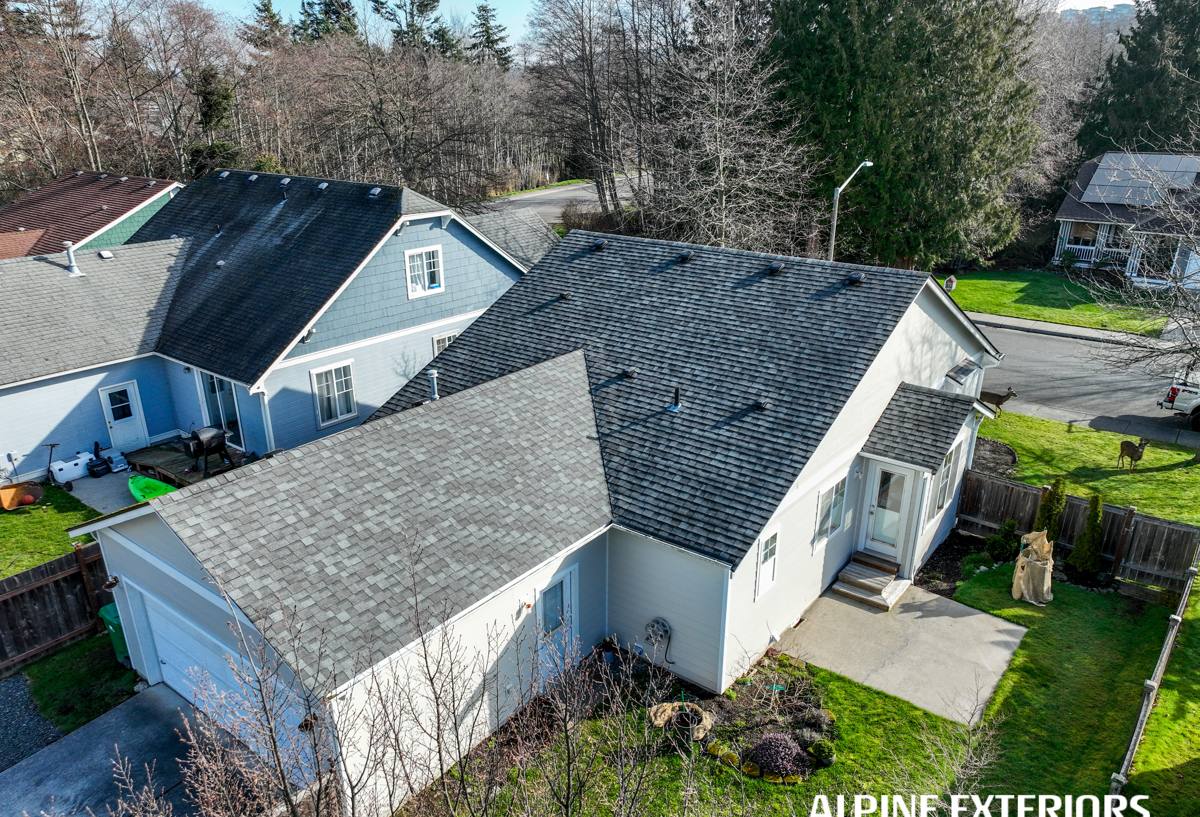
What the Regional Climate Actually Does to a House
Whatcom County sits close enough to the water that salt air is a real factor, even well inland from the immediate shoreline. Add driving rain off the Sound, a moss season that can run most of the year in shaded lots, and long stretches of overcast, moisture-saturated weather, and you get an exterior environment that punishes anything with a weak point. This isn't a place where "it'll dry out eventually" is a safe assumption — for a lot of the year, exteriors here simply don't get a real drying window.
The specific failure patterns we see
- Moss and algae staining on north- and east-facing walls that stay shaded most of the day
- Paint failure and bubbling on old wood or hardboard siding where moisture has gotten behind the surface
- Soft or delaminating siding at the bottom courses, near grade, and around downspouts
- Rot at window sills, trim returns, and butt joints where caulking has failed and gone unnoticed
- Roof moss buildup that holds moisture against shingles and shortens roof life
- Corrosion on fasteners and flashing exposed to salt-tinged air over many years
None of this is unique to Sunnyland, but the combination of tree shade, older construction, and coastal moisture makes this neighborhood a good example of why exterior material choice matters more here than in a drier climate.
Why We Standardized on One Siding Product
We install James Hardie fiber cement siding exclusively. We don't install vinyl, LP SmartSide, Cemplank, Allura, primed spruce, or cedar. That's not a marketing position — it's the result of years of pulling old siding off houses in this exact climate and seeing what held up and what didn't.
Wood and wood-composite products need a functioning paint film to stay protected, and in a shaded, damp environment like a lot of Sunnyland lots, that paint film gets tested constantly. Vinyl doesn't rot, but it moves with temperature, can crack in impact-prone areas, and offers limited real protection against the moisture intrusion that causes the rot problems underneath it. Fiber cement, done right, doesn't share those weak points — it's non-combustible, dimensionally stable, and doesn't feed mold or moss the way organic wood fiber can.
What James Hardie brings specifically
- A factory-applied ColorPlus finish, so the color isn't relying on a field-applied paint job to hold up against this climate
- HZ5 product engineering, which is built around freeze-thaw and moisture cycling relevant to the Pacific Northwest
- A long, transferable material warranty backed by a manufacturer with decades in fiber cement, not a newer entrant to the category
- Consistent plank and panel profiles that hold a straight, tight reveal line for the life of the siding
We're upfront that Hardie siding costs more upfront than vinyl and is heavier and more particular to install correctly than most alternatives. We think that trade-off is worth it on homes that are going to sit under tree cover in a wet coastal climate for the next 30-plus years.
How the Common Siding Choices Actually Compare Here
| Material | Moisture behavior in this climate | Maintenance burden | Why we don't install it |
|---|---|---|---|
| Vinyl | Sheds water but traps moisture behind panels if flashing is imperfect | Low, but hides problems until they're advanced | Limited protective value; can crack and fade under UV and temperature swings |
| LP SmartSide / Cemplank / Allura | Engineered wood or alternative fiber cement; varies by product | Moderate — install quality matters a lot | We standardized on one system we know inside and out rather than juggling multiple product lines |
| Primed spruce / cedar | Absorbs moisture readily; needs an intact paint film to stay protected | High — repaint and caulk maintenance is ongoing | Organic wood fiber struggles in sustained shade and damp; repaint cycles are frequent |
| James Hardie fiber cement | Non-combustible, dimensionally stable, engineered for moisture cycling | Low once installed to spec | Our standard product |
Roofing, Windows, and Decks — the Rest of the Envelope
Siding is only part of the picture. In a neighborhood with this much tree cover, roofs take a beating from moss, needle debris, and shaded valleys that never fully dry out. We handle roof replacement and repair with an eye toward the same moisture logic we apply to siding — proper underlayment, ventilation, and flashing details matter more here than in a drier climate, and cutting corners on any of them shows up as a leak within a few winters, not decades.
Windows in older Sunnyland homes are frequently original single-pane or early dual-pane units with failed seals, fogged glass, and drafty frames. Beyond the comfort and energy cost of that, failed window seals and deteriorated trim are a common entry point for the water damage we described above. Replacing windows at the same time as siding lets us address flashing and trim details as one continuous system instead of patching around old work.
Decks in this climate face the same moss and moisture exposure as roofs and siding, especially decks tucked under tree canopy that rarely see direct sun. We build and repair decks with drainage and material choices that account for that reality rather than assuming a dry, sunny site.
Why a Local Crew Matters for This Kind of Work
A lot of exterior problems in this region aren't visible from the ground. Moss on a north-facing wall, soft trim behind a downspout, or a roof valley that's held water for years all require someone who knows to actually look for them — and who's seen the same failure patterns often enough to know where to check first. A crew that works Whatcom County regularly knows which details fail here specifically, not just in general.
There's also a practical side to hiring local: warranty and service calls are easier when the company that installed your siding is a short drive away, not a regional outfit passing through on a subcontractor basis. If something needs a look five or ten years down the road, that matters.
What to Ask Any Contractor Before You Hire Them
- Are you licensed and insured in Washington, and can you provide proof?
- Do you install one siding system you stand behind, or whatever the customer requests?
- How do you handle flashing and moisture management at windows, doors, and butt joints?
- What does the manufacturer's warranty actually cover, and is it transferable if you sell the home?
- Can you walk me through what a full exterior assessment of my home would look like — not just a siding quote?
What an Assessment Looks Like
When we come out to a Sunnyland home, we're not just measuring wall square footage. We look at moss and moisture staining patterns, check trim and window sills for soft spots, look at roof condition and ventilation, and note any drainage issues around the foundation that might be feeding moisture problems at the siding level. That gives us — and you — a real picture of what needs attention now versus what can wait, instead of a quote based on a drive-by look.
Get a Straight Answer on Your Home
If your siding, roof, windows, or deck are showing wear from Whatcom County's wet, shaded conditions, we're happy to take a look and give you an honest read on what's actually going on — no pressure, no upsell script. Request a free estimate below and we'll set up a time to walk the property with you.