 Sudden Valley
 Why Color Is a Bigger Decision Than It Looks
Most homeowners treat siding color as the last decision in a project — pick a swatch, sign off, move on. On a Sudden Valley home, that's a mistake. The color you choose isn't just sitting on the wall; it's sitting through driving rain off Lake Whatcom, a long stretch of shade under second-growth trees, and a moss season that runs most of the year in this part of Whatcom County. Whatever finish is on your siding has to survive that environment without fading, chalking, or letting moisture behind it. That's a materials question as much as a design one, and it's the reason we install James Hardie fiber cement with its factory-applied ColorPlus finish rather than siding that gets painted after the fact.
This guide walks through how Hardie's color system actually works, what the different color families look like in practice, and how to think about choosing one for a lake-community home surrounded by conifers rather than a wide-open, sun-baked lot.
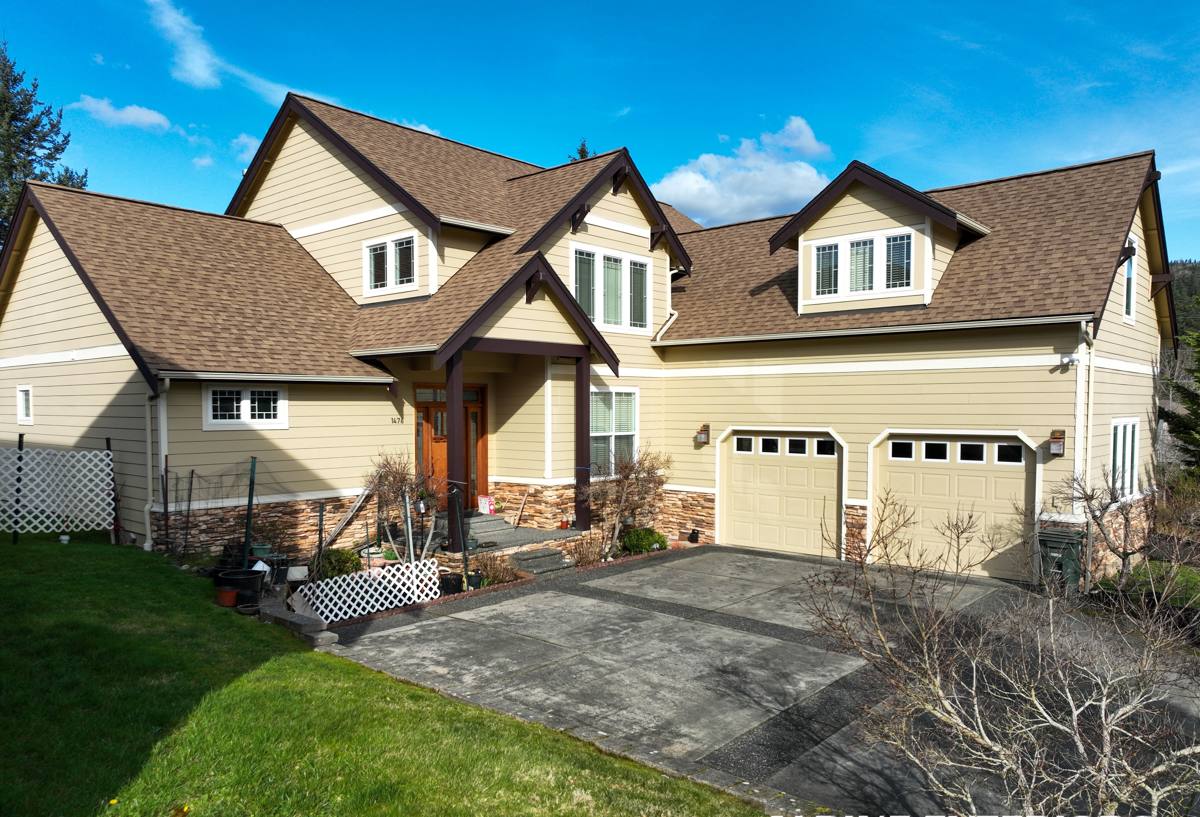
How ColorPlus Technology Actually Works
Field-applied paint — the kind used on cedar, primed wood trim, or touch-up work on most siding types — is sprayed or rolled on-site, at ambient temperature, over a surface that's already been exposed to whatever the weather did that week. ColorPlus is different. Hardie applies the finish at the factory, in a controlled environment, using a baked-on process with multiple coats cured before the board ever reaches a job site. That difference matters most in exactly the kind of climate Sudden Valley has:
- Better adhesion: a factory-cured finish bonds to the fiber cement more consistently than a field-applied coat going on over variable temperature and humidity.
- More even coverage: every board gets the same number of coats under the same conditions, instead of finish thickness varying by who sprayed it and how humid the air was that day.
- Better fade and moisture resistance: the cured finish resists UV breakdown and moisture intrusion longer than a field coat, which matters on shaded, damp elevations that rarely get a full day of direct sun to help a field-applied paint cure and stay put.
The practical result is a finish that's engineered to look consistent for a long time, rather than one that depends on perfect weather during application to hold up at all.
What "Baked-On" Doesn't Mean
It's worth being precise here: ColorPlus doesn't make the siding indestructible, and it isn't a substitute for correct installation. A poorly flashed wall or an installation that traps moisture behind the panels will still cause problems regardless of how good the surface finish is. Color performance and moisture management are separate issues, and a homeowner evaluating a Hardie quote should ask about both — not just which color they're getting.
The Hardie Color System: How the Choices Break Down
Hardie organizes its ColorPlus offerings into a few different tiers, which is useful to understand before you start looking at samples, because it affects both appearance and, in some cases, cost and lead time.
| Category | What It Is | Typical Use |
|---|---|---|
| Statement Collection | Hardie's standard palette of ColorPlus factory colors, offered across most product lines | The most commonly chosen colors for full-home siding |
| Dream Collection | An expanded, designer-curated palette with additional shades beyond the core Statement lineup | Homeowners wanting a less common color or a specific design scheme |
| Primed (unfinished) | Hardie board with a factory primer coat but no ColorPlus topcoat, meant to be field-painted after install | Custom or unusual colors not available in ColorPlus, or matching an exact existing paint color |
Primed Hardie is a legitimate option when a homeowner wants a color outside the ColorPlus lineup, but it's worth understanding the trade-off: once you go to a field-applied topcoat, you lose the factory-cure advantages above, and the finish becomes a normal exterior paint job that will need repainting on a normal paint-job timeline — likely sooner in a shaded, damp setting than in full sun. We'll walk homeowners through that trade-off honestly rather than upselling one option over the other.
Common Color Families
Within the Statement Collection, colors generally fall into a few visual families that tend to come up again and again in this region: warm neutrals (tans, khakis, light taupes), cool grays and slates, deep charcoals and near-blacks, muted greens and blues that read well against evergreen backdrops, and classic whites and off-whites. Names like Arctic White, Iron Gray, Mountain Sage, Boothbay Blue, Timber Bark, and Aged Cedar are examples of the kind of range Hardie offers — the exact lineup and names shift over time, so we always work from current physical samples rather than assuming a color from a photo or an old brochure is still in production.
Choosing Colors for a Sudden Valley Property
Working With Tree Cover, Not Against It
Sudden Valley lots are, on average, more heavily shaded than a typical in-town Bellingham property. That changes how color reads on the house. A very light color can look flat or slightly gray under constant canopy shade instead of bright and crisp the way it might in full sun. Darker, warmer tones — deep greens, warm grays, rich browns — often read better against a backdrop of conifers and dappled light than they would on an open, sunny lot. This isn't a hard rule, but it's worth viewing large color samples on-site, in the actual shade pattern your home sits in, rather than trusting how a chip looks under indoor lighting or on a sunny showroom wall.
Lake Light and Reflected Glare
Homes with a lake-facing elevation get a different kind of light than shaded, tree-covered walls on the same house — reflected light off the water can brighten a wall that would otherwise sit in shadow most of the day. If your lot has that kind of split exposure, it's worth thinking about whether you want a single color across the whole house or whether trim and accent choices should account for the fact that one elevation sees noticeably more light than another.
HOA Considerations
Sudden Valley operates under its own homeowners association with architectural guidelines that can include color approval. Before finalizing a color, homeowners should confirm what the HOA's current requirements are and, if required, get approval before ordering materials. We're glad to help homeowners assemble the documentation an HOA review typically asks for, but the approval itself is between the homeowner and the association.
Trim, Accent, and Multi-Color Schemes
Most homes read best with a coordinated system rather than a single flat color everywhere: a primary field color for the main siding, a contrasting or complementary trim color, and sometimes a third accent color on shutters, a front door surround, or a gable feature. Hardie's trim boards and accessories are available in ColorPlus finishes as well, which means the same factory-cure advantages apply to trim as to field siding — an important detail, since trim edges and corners are often the first place a field-painted product shows wear.
A Practical Checklist When Picking Colors
- View large physical samples outdoors, in the actual light and shade conditions on your lot — not just a small chip indoors
- Check current Sudden Valley HOA architectural guidelines before finalizing a choice
- Decide on field, trim, and accent colors together as a system, not one at a time
- Ask whether your chosen colors are in the standard Statement Collection or the expanded Dream Collection, since availability and lead time can differ
- If considering a non-ColorPlus color on primed board, ask specifically what the repainting timeline will look like in a shaded, damp setting
- Confirm the color match between siding and trim products, since they sometimes come from different production runs
How Long ColorPlus Finishes Actually Last
Hardie backs its ColorPlus finish with a dedicated finish warranty separate from the substrate warranty on the fiber cement board itself — meaning the color and finish performance are covered on their own terms, not just the durability of the underlying material. The specifics (length of coverage, what's included) are spelled out in Hardie's published warranty documentation, and we go over the current terms with every homeowner before a project starts rather than relying on general assumptions about "lifetime" coverage. In practical terms, ColorPlus finishes are built to go a long time — often a decade or more — before most homeowners consider repainting, especially compared to a field-painted product in a shaded, wet climate like this one.
What Actually Shortens Finish Life Here
Even a good factory finish is affected by real-world conditions. In Sudden Valley, the two biggest factors we see are prolonged moisture contact from moss and organic debris sitting against the siding, and physical damage from pressure washing at too high a setting or too close a distance. Both are avoidable with basic care, which we cover below.
Maintaining Color Over Time
ColorPlus is low-maintenance, not no-maintenance. Keeping it looking right for the long haul mostly comes down to a few habits:
- Rinse siding periodically with a garden hose and soft brush rather than a pressure washer, which can force water behind panels or strip finish if used incorrectly
- Keep gutters clear and downspouts directed away from siding so runoff doesn't sit against the bottom courses
- Trim back vegetation and tree limbs that hold moisture against a wall or keep a section in permanent shade and damp
- Address moss or algae growth promptly with a gentle cleaning approach rather than letting it establish, since organic growth held against the finish over a full wet season is harder on the surface than an occasional rinse
None of this is unusual maintenance for an exterior in this part of Washington — it's the same basic upkeep a shaded, lakeside property needs regardless of siding material. The difference is that a ColorPlus finish gives you a longer runway before any of it becomes urgent.
Why We Only Offer This System
We don't install vinyl, LP SmartSide, Cemplank, Allura, primed spruce, or cedar, and color performance is part of why. Vinyl doesn't take a factory paint finish the way fiber cement does — its color is baked into the material itself, which limits both the palette and the ability to refresh it later without replacing panels. Cedar and primed wood need to be field-finished from day one and re-finished on a repainting cycle for as long as you own the house, and that cycle runs faster on a shaded, damp Sudden Valley lot than it would on an open, sunny one. We'd rather stand behind one system — factory finish, climate-engineered board, a real warranty — than sell a homeowner a cheaper product and leave the long-term color upkeep as their problem to manage.
If you're planning new siding, a color refresh on an existing Hardie installation, or just want to see physical ColorPlus samples in your own yard's actual light, we're happy to walk through it with you. Reach out below for a free, no-pressure estimate.