 Sudden Valley
 Silver Beach's Exterior Problem Isn't One Thing — It's Three
Homes around Silver Beach and the rest of the Lake Whatcom corridor deal with a combination of exposures that most siding products simply weren't engineered to handle all at once. There's the salt-laden air that drifts in off the greater Puget Sound region, there's driving, wind-pushed rain that hits siding sideways instead of straight down, and there's the deep tree canopy common to this part of Whatcom County that keeps north- and west-facing walls damp and shaded for long stretches of the year. Individually, any one of those is manageable. Together, over a decade or two, they're what separates a home that still looks sharp at year fifteen from one that's showing rot, peeling paint, and moss-blackened trim.
Wood-based and wood-adjacent siding products lose this fight slowly. Moisture gets into a seam or a cut edge, the tree cover keeps that spot from ever fully drying out, and by the time it's visible from the ground, the damage underneath is usually further along than it looks. That's the core reason we standardized on James Hardie fiber cement for every siding job we install — it's a product built to shrug off exactly this kind of climate instead of slowly losing to it.
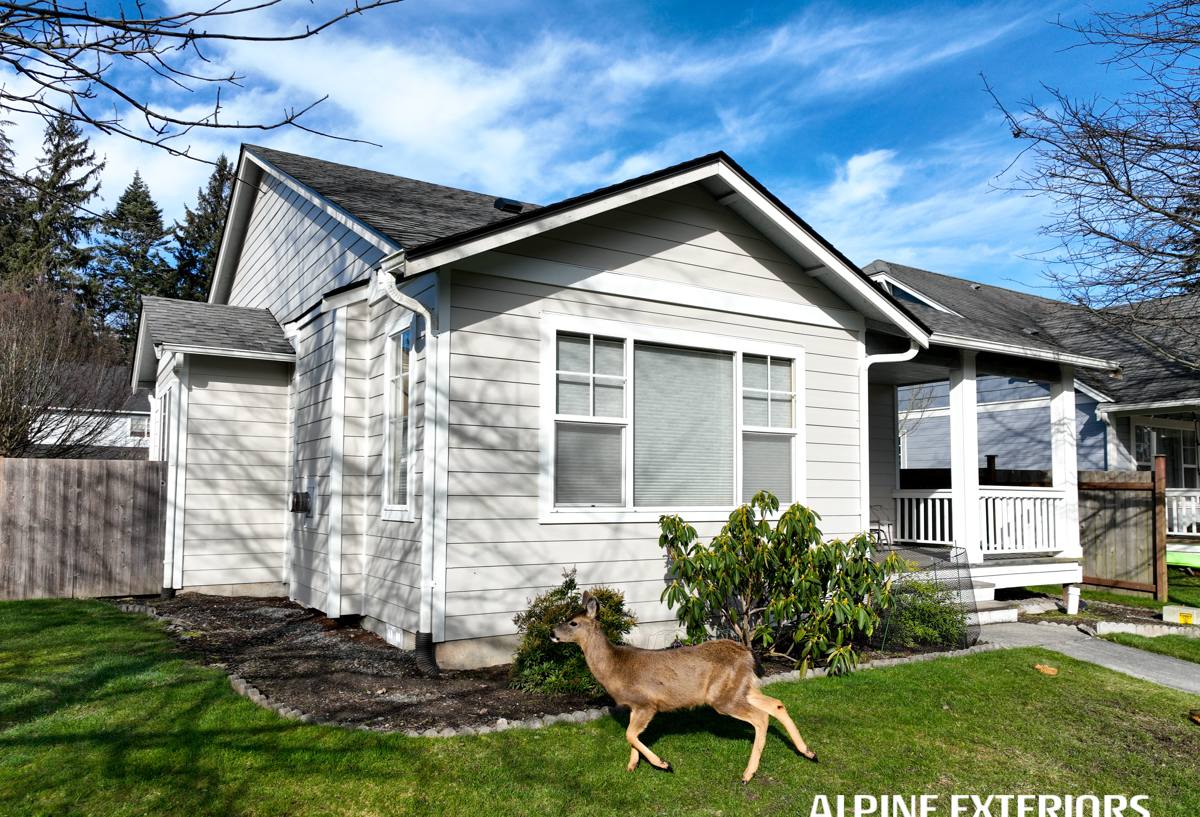
Why This Company Installs Only James Hardie Fiber Cement
We don't install LP SmartSide, vinyl, Cemplank, Allura, primed spruce, or cedar. That's not a marketing position — it's a decision based on what actually holds up in Northwest Washington conditions over the long haul. James Hardie fiber cement is made from cement, sand, and cellulose fibers, which means it doesn't feed mold or moss the way wood-based products do, it doesn't warp or swell when it takes on moisture at a cut edge, and it's non-combustible, which matters more each year as wildfire smoke and dry-season fire risk become a bigger part of the Pacific Northwest conversation.
We're not going to tell you every alternative product is bad — most of them work fine somewhere. Engineered wood siding performs reasonably well in drier inland climates with good roof overhangs and diligent maintenance. Vinyl is inexpensive and easy to install. Cedar has real aesthetic appeal and a long tradition in this region. But none of them are what we'd choose for a home that sits under tree cover a few miles from open water, catching driving rain and salt air for nine months of the year. Fiber cement is.
What "Climate-Engineered" Actually Means
James Hardie makes different siding formulations for different climate zones — it's not a one-size-fits-all product. The HZ5 formulation used throughout Western Washington is engineered specifically for regions with sustained moisture exposure, resisting moisture-related damage better than a general-purpose formulation would. That distinction matters more in a place like Silver Beach than it would in a dry inland climate, because the product is doing real work here, not just sitting on the wall looking good.
How Moss and Moisture Actually Damage a Home's Exterior
Moss itself doesn't eat siding, but it does something arguably worse: it holds water against the wall surface for days or weeks at a time, well past the point where the siding would otherwise have dried out. On wood-based products, that sustained dampness is exactly what triggers rot at seams, fastener holes, and cut edges. On paint film, it accelerates peeling and cracking. On caulking, it breaks down the seal faster than manufacturer warranties assume.
Driving rain compounds the problem because it doesn't behave like a gentle vertical shower — wind-driven rain gets pushed sideways and upward into laps, seams, and trim joints that were only ever designed to shed water moving straight down. That's why correct installation detail (proper lap exposure, flashing at every horizontal joint, sealed and back-primed cut edges) matters as much as the product itself. A great product installed with sloppy flashing will still leak. A good product installed to spec will outperform a great product installed carelessly.
James Hardie's ColorPlus Finish in a Salt-Air, Shaded Environment
Standard field-painted siding is only as good as its paint job, and paint jobs in a shaded, damp climate degrade faster than manufacturers' generic warranty language assumes. James Hardie's ColorPlus finish is baked on at the factory in a controlled environment, which gives it better adhesion and more consistent coverage than a paint crew can achieve on a job site — especially on a day with the kind of humidity that's common around Lake Whatcom. That factory finish also comes with its own finish warranty, separate from the substrate warranty, which is part of why we consider it the stronger overall package for homes in this area.
Roofing, Windows, and Decks: The Rest of the Building Envelope
Siding doesn't work in isolation — it's one piece of a building envelope that also includes the roof, the windows, and any exterior decking. We handle all four, and that matters in a climate like this one because water problems rarely respect trade boundaries. A roof that's shedding water onto a wall in the wrong spot, or a window that's not flashed correctly into the siding plane, can undo even a perfect fiber cement installation. When we're on a property for a siding project, we're looking at the whole envelope, not just the walls.
- Roofing: proper flashing, ventilation, and moss-resistant material choices that work with the siding plane, not against it
- Windows: correct flashing integration where window and siding meet — one of the most common leak points on older Northwest homes
- Siding: James Hardie fiber cement, installed to manufacturer spec for this climate zone
- Decks: materials and detailing chosen to handle standing moisture and shade, not just look good on installation day
What Correct James Hardie Installation Actually Involves
A lot of siding failures — on any product — trace back to installation shortcuts rather than the material itself. For fiber cement specifically, there are a handful of details that make the difference between a wall that performs for decades and one that develops problems in five or six years:
- Minimum clearance maintained between siding and grade, decks, patios, and roof lines so water and soil moisture can't wick into the bottom edge
- Correct lap exposure and fastener placement, per the manufacturer's installation manual for this climate zone
- Flashing installed at every horizontal joint, window, door, and penetration — not just caulk alone
- Cut edges sealed before installation, since an unsealed cut edge is the fastest path for moisture intrusion
- Proper fastener type and spacing, avoiding both under-fastening and over-driving
- Ventilation gap maintained behind the siding where the assembly calls for it, so incidental moisture can dry out instead of getting trapped
None of this is exotic — it's published in Hardie's own installation guidelines. But it takes a crew that installs this product regularly, in this climate, to get all of it right on every wall of the house, not just the parts that are easy to reach.
What Drives Cost on a Silver Beach Siding Project
Every home is different, but the factors that move the price up or down are consistent. We give a firm number after walking the property — not before — but this is generally what we're weighing:
| Factor | Why It Matters |
|---|---|
| Existing siding removal | Tear-off and disposal of old wood, vinyl, or damaged material adds labor before installation even starts |
| Sheathing and moisture damage found underneath | Rot discovered once old siding comes off has to be repaired before new siding goes up — common on shaded, older homes in this area |
| Home shape and trim detail | Dormers, multiple gables, and heavy trim work take more time per square foot than a simple rectangular wall |
| Siding profile chosen | Lap width, shake-style panels, and board-and-batten each have different material and labor costs |
| Access and site conditions | Steep lots, limited driveway access, and heavy tree cover near the walls all affect scaffolding and staging time |
| Accompanying work | Bundling roofing, window, or deck work into the same project can reduce overall mobilization costs |
A Realistic Maintenance Outlook
One of the honest selling points of fiber cement over wood-based alternatives is how little ongoing maintenance it needs — but "little" isn't "none," especially under tree cover. A simple annual routine keeps a Hardie exterior performing the way it's designed to:
| Task | Frequency |
|---|---|
| Rinse siding to remove pollen, moss spores, and grime buildup | 1-2 times per year |
| Inspect caulking at trim, windows, and joints | Annually |
| Clear debris and overhanging branches from shaded wall sections | Annually, or as growth requires |
| Check gutters and downspouts for proper drainage away from siding | Twice a year, before and after peak rain season |
Why a Local Crew Is Worth Insisting On
A crew that mostly installs vinyl in a dry inland market, then takes on an occasional fiber cement job near Lake Whatcom, is going to make different assumptions than a crew that installs Hardie in this specific climate week in and week out. Local experience means knowing which walls on a shaded lot need extra attention to drying time, understanding how Whatcom County's building and permitting requirements apply to exterior replacement, and having already seen what five years of driving rain and moss exposure does to a poorly flashed installation — so it doesn't happen on yours.
If you're planning a siding, roofing, window, or deck project in Silver Beach or elsewhere around Sudden Valley, we're happy to walk the property, look at what your home is actually dealing with, and put together a straightforward, no-pressure estimate. There's no cost and no obligation to get a second set of eyes on it — just fill out the form below.