 Sudden Valley
 Why Decks in Sunnyland Wear Out Faster Than the Manual Says
Every deck board and every bag of fasteners comes with a manufacturer's estimate of how long it should last. In Sunnyland, that number is mostly theoretical. Sunnyland sits close enough to Bellingham Bay that salt-laden air reaches wood, hardware, and fasteners on a regular basis, and like the rest of Whatcom County it sits inside a genuinely wet climate — long stretches of driving rain from fall through spring, followed by a moss season that can stretch five or six months on any deck that doesn't get much sun or airflow. None of that is a flaw in your deck. It's just the environment it has to survive, year after year, and it's why a deck that would last two or three decades somewhere dry and inland can start showing real problems here in half that time.
Salt air accelerates corrosion in fasteners, joist hangers, and any exposed metal flashing, often from the underside where nobody looks. Driving rain doesn't just wet the surface of a deck — wind-driven rain gets pushed up under boards, into end grain, and behind ledger boards where it can sit for days without drying. And moss doesn't just look bad; it holds moisture against the decking surface and the framing underneath long after the rain has actually stopped, which is exactly the condition wood rot and hidden decay need to get started.
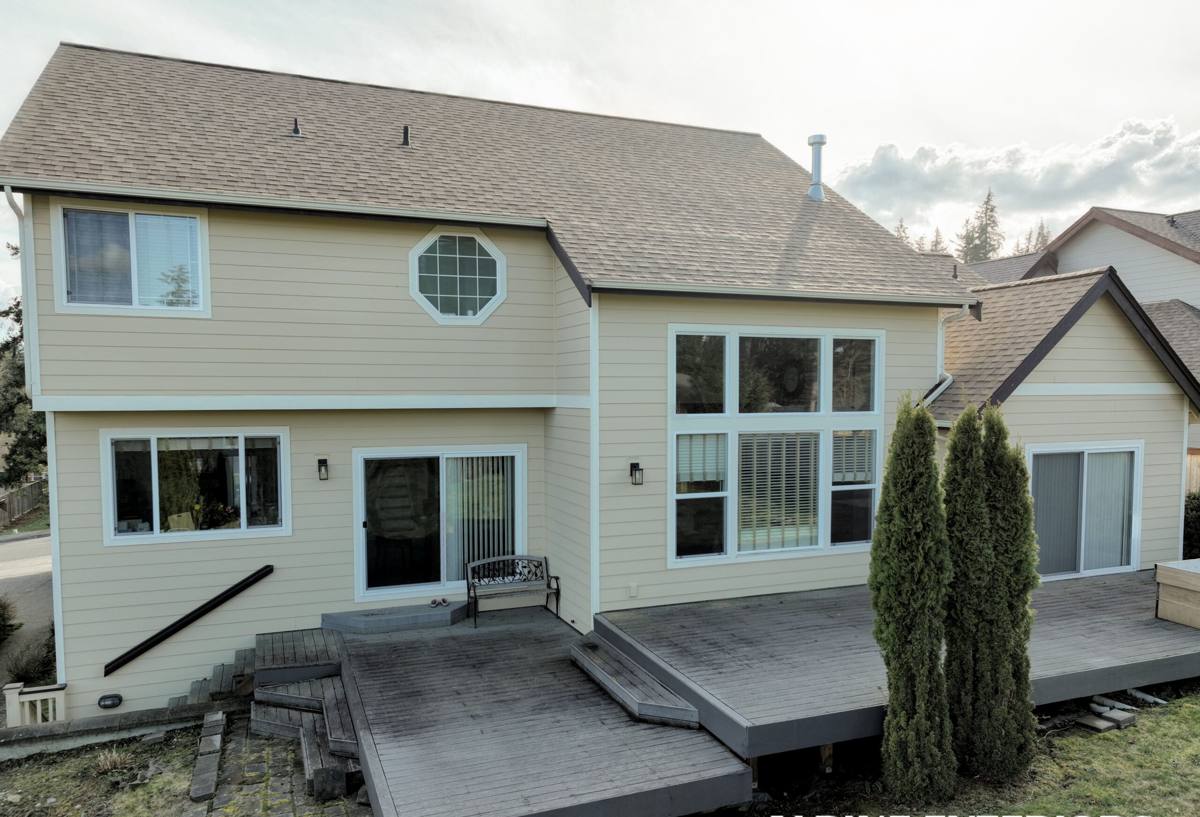
Signs a Sunnyland Deck Needs Replacement, Not Just Repair
Not every deck problem calls for a full tear-out. Boards can be swapped, railings can be re-secured, and a good cleaning can buy real time. But there's a point where patching individual boards and scrubbing moss stains is just delaying a bigger, more expensive failure underneath. Here's what we look for when deciding whether repair still makes sense:
- Soft or spongy spots underfoot, especially near the house or at the base of posts
- Boards that keep cupping, splitting, or popping fasteners again shortly after being fixed
- Rust streaks bleeding down from screws, nail heads, or joist hangers
- Discoloration or separation where the ledger board meets the house
- Moss or black-green staining that returns within a few weeks of cleaning
- Railings, stairs, or posts that feel loose or flex under normal weight
- A deck 15-20+ years old that has never had the substructure inspected
If two or more of these apply, it's worth having someone actually get underneath the deck and look at the framing, not just the boards on top. That's usually where the real story is.
What a Correct Deck Replacement Actually Involves
The Substructure Most People Never See
A deck is only as good as what's underneath it. A proper replacement means checking — and where needed, replacing — the ledger board, joists, beams, posts, and footings, not just laying new boards over old framing. In a climate that stays damp for much of the year, framing lumber that looks fine from a quick glance can be soft or compromised where it's been sitting against moisture for years. We don't reuse framing just because it's still standing; we reuse it because it's actually sound.
Ledger Board and Flashing: The Part That Actually Fails
Most serious deck failures don't start in the decking boards — they start at the ledger board, where the deck attaches to the house. This connection has to be flashed correctly so that water sheds away from the house rather than getting trapped behind the deck and running down into the wall framing. It's the single most common thing we find done wrong on older decks in this area, and it's not something you can inspect from the top down. Correct flashing at this joint matters more here than almost anywhere else, precisely because of how much rain the region gets and how long that rain lingers in the air.
Decking Surface and Fastening
Once the structure is sound, the decking surface and the fasteners holding it down are what actually stand up to salt air and rain day to day. Hidden fastener systems, corrosion-resistant screws, and proper gapping between boards for drainage and airflow all make a measurable difference in how long the surface stays solid and how much moss and algae take hold between cleanings.
Choosing a Decking Material for Local Conditions
There's no single "best" decking material — there's a best material for your budget, your maintenance appetite, and how much sun your particular deck gets. A shaded deck under trees, common in parts of Sunnyland, is going to grow moss faster than one that gets afternoon sun, regardless of material. Here's how the common options actually perform under salt air, driving rain, and a long moss season:
| Material | Salt Air / Rain Behavior | Moss & Algae Tendency | Ongoing Maintenance |
|---|---|---|---|
| Pressure-treated wood | Holds up well if fasteners and flashing are corrosion-resistant; end grain needs sealing | Moderate to high on shaded decks without regular cleaning | Annual cleaning and periodic sealing/staining |
| Cedar | Naturally rot-resistant but softer; still needs sealed end cuts and good drainage | Moderate; greys and can stain if left untreated | Regular sealing to preserve color and resist moisture uptake |
| Composite decking | Doesn't absorb water like wood; performs consistently in wet, salty conditions | Lower on capped/textured products; smooth or uncapped composites can still grow algae in shade | Occasional washing; no sealing or staining |
| PVC / capped polymer | Fully water-resistant surface; best resistance to salt exposure and standing moisture | Lowest of these options with routine rinsing | Minimal — periodic cleaning only |
We'll talk through these trade-offs honestly during an estimate rather than pushing whatever has the best margin. A well-installed pressure-treated deck with correct flashing and fasteners can outlast a poorly installed composite deck, and vice versa. Installation quality matters more than the brand name on the board.
Our Deck Replacement Process
- On-site assessment. We inspect the existing deck top to bottom — decking, framing, ledger connection, footings, and any moisture or rot already present — before quoting anything.
- Scope and material walkthrough. We go over decking material options, hardware, and layout with you, including honest maintenance expectations for each.
- Permitting. Where required by the city or county, we handle the permit application and any inspections tied to it.
- Careful tear-off. Removal of the old decking, railings, and any compromised framing, checking as we go for hidden damage the initial inspection couldn't fully see.
- Structural rebuild. New or repaired ledger board with correct flashing, joists, beams, and footings sized and spaced to code.
- Decking and railing installation. Installed with corrosion-resistant fasteners and proper board spacing for drainage and airflow underneath.
- Final walkthrough. We check the finished deck with you, including how to maintain it through the wet months ahead.
What Drives the Cost of a Deck Replacement
Deck replacement costs vary widely — a small, straightforward deck on solid existing footings runs far less than a large multi-level deck with structural rot to correct. Rather than quote a single number that won't fit most homes, here's what actually moves the price:
| Factor | Why It Matters |
|---|---|
| Deck size and layout | Square footage, number of levels, and stairs all add material and labor |
| Condition of existing framing | Rotted joists, posts, or footings found during tear-off add rebuild scope |
| Decking material chosen | Pressure-treated wood, cedar, composite, and PVC sit at different price points |
| Railing style and hardware | Code-compliant railings and corrosion-resistant hardware vary in cost by material |
| Permit and inspection requirements | Height, attachment to the house, and local code trigger different permit needs |
| Site access | Slope, tree cover, or tight access around the house can add labor time |
We give a written, itemized quote after the on-site assessment so you know what you're paying for and why — not a rough number pulled from a phone call.
Permits and Code in Whatcom County
Most full deck replacements — especially anything attached to the house, elevated, or involving new footings — require a permit, and inspections are typically tied to the framing and ledger connection before decking goes down. Skipping this isn't a shortcut worth taking: an unpermitted deck can complicate a future home sale, and more importantly, the inspection process exists specifically to catch the ledger and footing mistakes that cause failures down the road. We handle the permit application and coordinate inspections as part of the job, so it's one less thing on your plate.
Keeping a New Deck Ahead of Moss Season
A correctly built deck still needs some basic upkeep to get the full lifespan out of it, especially in a climate where moss has months to establish itself. None of this is complicated, but it does need to actually happen on a schedule:
- Sweep debris and leaves off the deck regularly through fall, before they trap moisture against the boards
- Clean the surface at least once a year, ideally before the wettest months set in
- Keep gutters and downspouts near the deck clear so runoff isn't draining directly onto it
- Check and clear the gap between boards periodically so water keeps draining through, not sitting on top
- Reseal wood decking on the manufacturer's recommended schedule — don't wait until it looks obviously worn
- Trim back overhanging branches where possible to get more sun and airflow onto shaded sections
- Walk the deck once or twice a year checking for soft spots, loose railings, or new staining
Why a Crew That Already Works Sunnyland Makes a Difference
Deck replacement isn't a generic job you can spec the same way everywhere. A crew that already works in Sunnyland and the broader Bellingham area knows which fastener and hardware grades actually hold up against salt air here, how aggressively moss establishes itself on shaded lots near mature trees, and how much drainage and airflow a deck really needs to stay ahead of a wet Whatcom County winter. That local experience shows up in decisions a homeowner might never think to ask about — hardware selection, board spacing, flashing detail — long before it shows up as a problem five years later.
If your deck in Sunnyland is showing its age, or you're planning ahead before it gets worse, we're happy to take a look and give you a straightforward, no-pressure estimate — free, with a written scope so you know exactly what you're getting and why. Use the form below to get started.