 Sudden Valley
 Why Fairhaven Siding Wears Differently Than Siding Inland
Fairhaven sits close enough to the water that homes there deal with a combination most inland Whatcom County properties never see: salt-laden air off Bellingham Bay, driving rain that comes in sideways during winter storms, and a moss season that can run from October clear through April. Any one of those on its own is manageable. Together, over years, they find every weak point in a home's exterior — a nail that backed out, a caulk joint that dried and cracked, a corner trim piece that was never properly flashed.
Salt air is corrosive to fasteners and metal flashing in ways plain rain isn't. Driving rain doesn't just wet a wall — it drives moisture sideways and upward, past laps and seams that would shed a straight-down rain just fine. And moss doesn't just look bad; it holds water against the siding surface for weeks at a time, which is exactly the condition that rots wood-based products and telegraphs stains through paint. A siding repair in Fairhaven has to account for all three, not just patch the visible damage and move on.
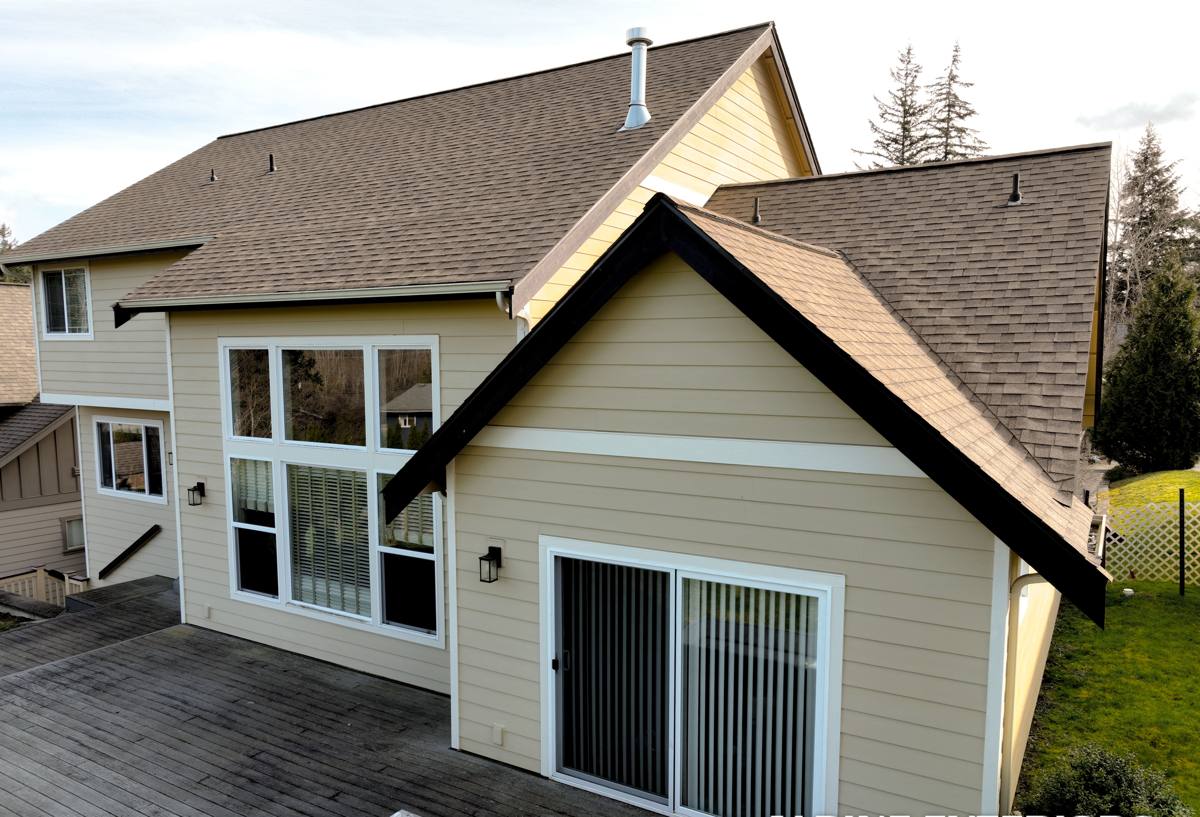
The Warning Signs Worth Acting On
Most siding problems we're called out for in this neighborhood didn't start as emergencies. They started small and got ignored through a wet winter or two. Here's what we'd want a Fairhaven homeowner to flag early:
- Soft or spongy spots when you press on the siding, especially near the bottom courses or around window trim
- Visible gaps at butt joints, corners, or where siding meets trim, flashing, or the foundation
- Persistent moss or algae staining that keeps coming back within a season of cleaning
- Paint that's bubbling, peeling, or has a chalky residue in patches rather than evenly across a wall
- Dark streaking below nail heads or seams, which usually means water is tracking behind the panel
- Warping, cupping, or visible separation of boards from the wall sheathing
None of these mean the whole wall needs to come off. But every one of them means water has found a way in, and the longer it sits there, the more it costs to fix — both in siding and in whatever's behind it.
What a Correct Repair Actually Involves
It starts behind the siding, not on top of it
A repair that only addresses what's visible from the street is a repair that will fail again. Before we touch a replacement board, we're checking the house wrap or building paper behind the damaged section, the condition of the sheathing, and whether the flashing at windows, doors, and penetrations is doing its job. If moisture already got past the siding, patching over it just hides the problem for another season.
Matching, not guessing
James Hardie's ColorPlus finish is baked on at the factory in a controlled process, which means a board bought today and a board bought three years ago won't be an exact match if you're eyeballing it against sun-faded existing siding. A correct repair accounts for this — either by pulling boards from a less visible run to relocate to the damaged area, or by discussing realistic expectations on color match up front, rather than promising a seamless blend that field-painted patches can't deliver.
Fasteners and flashing done to spec
Fiber cement has specific fastening requirements — nail placement, penetration depth, and spacing all matter for how the board performs against wind-driven rain. Skipping or shortcutting these details is one of the more common reasons a repair job that looked fine on day one starts leaking again within a year.
Repair or Replace? How We Make That Call
Not every damaged section needs a full re-side, and not every repair is worth doing if the underlying siding is near the end of its life. We walk homeowners through the actual factors rather than defaulting to the more expensive answer:
| Factor | Leans toward repair | Leans toward replacement |
|---|---|---|
| Extent of damage | Isolated to a few boards or one elevation | Recurring issues across multiple walls |
| Age of existing siding | Under 10-15 years, otherwise sound | Original siding is decades old or a different material entirely |
| Underlying sheathing/wrap | Dry, intact when opened up | Soft sheathing, mold, or widespread moisture found behind panels |
| Color/finish match | Acceptable with minor variation | Faded finish makes any patch visibly obvious |
| Root cause | Localized (one bad flashing detail, one impact spot) | Systemic (original install wasn't detailed for this climate) |
We'll tell you plainly which category your situation falls into. If a repair will genuinely hold up, that's what we recommend — there's no reason to sell a full re-side when a section of Hardie board and correct flashing will do the job.
Why We Only Repair With James Hardie Fiber Cement
We don't stock or install vinyl, LP SmartSide, primed spruce, cedar, or other fiber cement brands like Cemplank or Allura — and that shapes how we approach repair work too. Vinyl siding can crack in cold snaps and doesn't hold paint if you want to change color down the road; patched sections are also notoriously hard to color-match since manufacturers discontinue and fade colors over time. Wood-based and OSB-based products like LP SmartSide can perform well when detailed and maintained precisely, but they're more sensitive to the exact kind of prolonged moisture exposure — driving rain plus moss cover plus salt air — that Fairhaven sees regularly; a repair there has less margin for error.
James Hardie fiber cement is non-combustible, dimensionally stable in wet climates, and its HZ5 product line is engineered specifically for wetter regions like ours. The ColorPlus factory finish resists the fading and peeling that plagues field-painted siding, and it carries a strong, transferable warranty when installed to Hardie's specifications. When we repair a Hardie home, we're working with a material that was built for this exact climate — and when we replace failing older siding, Hardie is what we put back up, because we've seen how it holds up here over time and we're not willing to install something we'd have to caveat.
How Our Repair Process Works
- On-site inspection. We look at the visible damage, but also probe adjacent areas, check flashing details, and if warranted, open up a small section to assess the wall assembly behind it.
- Honest scope and estimate. You get a clear breakdown of what needs to happen, why, and what it costs — including whether we recommend repair, partial re-side, or full replacement, and our reasoning.
- Correcting the cause, not just the symptom. If a flashing detail or gap let water in, that gets fixed as part of the repair, not left in place under new siding.
- Installing to Hardie's fastening and clearance specs. Correct nail pattern, proper gapping at joints, and ground/roofline clearances that keep future moisture and moss exposure to a minimum.
- Site cleanup and a final walk-through. You see the finished repair and get a plain explanation of what was done and what, if anything, to keep an eye on going forward.
Why Local Experience in Fairhaven and Sudden Valley Matters
A repair crew that mostly works drier inland areas will sometimes underestimate what Whatcom County's coastal-influenced weather does to an exterior over time. Working in and around Sudden Valley and Fairhaven regularly means we're not guessing at how much moss buildup to expect on a north-facing wall, or how aggressively wind-driven rain hits a home depending on its orientation to the water. That familiarity shows up in the details — where we double-check flashing, which corners we know tend to take the worst of it, and what maintenance timeline actually makes sense for this specific stretch of coastline rather than a generic recommendation.
Keeping a Repair From Becoming a Repeat Repair
Once your siding is fixed, a little seasonal attention goes a long way toward making sure it stays that way:
- Rinse siding annually, and more often on shaded or north-facing walls where moss takes hold fastest
- Trim back vegetation and tree limbs that keep siding in constant shade or drip zones
- Walk the exterior each fall and spring looking for new gaps, cracked caulk, or soft spots before winter rains arrive
- Keep gutters clear so overflow isn't running directly down a wall section
- Address small issues — a loose piece of trim, a cracked caulk line — before the next wet season, not after
If you're noticing early signs of trouble on your Fairhaven home, or you'd just like an honest opinion on whether a section of siding needs repair or full replacement, we're happy to take a look. Fill out the form below for a free, no-pressure estimate.