 Sudden Valley
 Why Roofs Age Faster Around Lake Whatcom
Homes around Lake Whatcom don't wear out the same way homes in an open subdivision do. Most lots here sit under a heavy canopy of fir, cedar, and hemlock, which means roofs spend a large part of the year in shade, catching needle and cone debris, and staying damp long after a storm has passed. Add in Whatcom County's overall wet climate — driving rain for much of the fall, winter, and spring, plus salt-tinged air moving in off Bellingham Bay and the broader Puget Sound coastline — and you get a roofing environment that's genuinely tougher than what a shingle warranty was tested for.
Shade and a long moss season
Moss needs shade and moisture to establish, and Lake Whatcom properties offer both in abundance. Once moss gets a foothold on a roof, it holds water against the surface, works its way under shingle tabs, and lifts granules as it grows. On a shaded, north-facing slope here, moss season can realistically run eight months or more out of the year, not just the classic "rainy season" window.
Rain volume, not just rain frequency
It isn't only how often it rains — it's how long roofs stay saturated between dry spells. A roof deck that never fully dries out is far more prone to rot, fastener corrosion, and slow leaks that don't show up as a stain on the ceiling until the damage is already extensive.
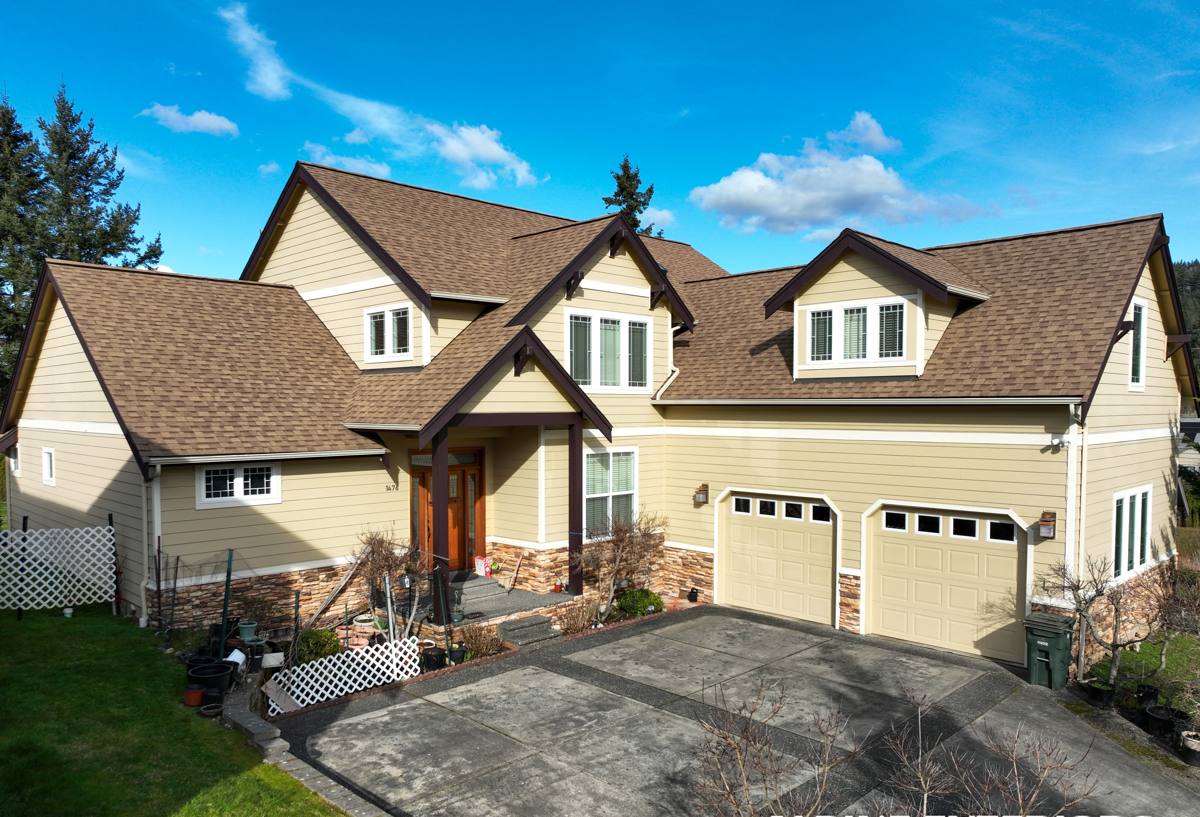
Signs a Lake Whatcom Roof Needs Replacing, Not Just Patching
Repairs make sense when a roof is otherwise sound and the problem is localized. Replacement makes sense when the underlying material and deck are wearing out everywhere at once, which happens sooner here than in drier parts of the state. Before you commit to another round of patch-and-hope, walk through this list:
- Shingles that are curling, cupping, or losing granules across large sections, not just one spot
- Moss or algae streaking that comes back within a season or two of cleaning
- Soft, spongy decking you can feel underfoot in the attic or from a ladder at the eaves
- Daylight visible through the roof deck from inside the attic
- Recurring leaks near valleys, chimneys, or skylights despite prior repairs
- Gutters filling with granules after every rain, a sign the shingles are shedding their surface
- A roof original to the house and now 20+ years old, especially on shaded slopes
If two or three of these apply at once, you're usually past the point where spot repairs are the honest answer.
What a Correct Roof Replacement Actually Includes
A roof replacement is more than swapping old shingles for new ones. Done right, it's a full system rebuild, and each layer matters more here than it would in a drier climate.
Tear-off and deck inspection
We remove the old roofing down to the deck rather than layering over it. That's the only way to find soft or rotted plywood or planking, which is common on Lake Whatcom homes where moss and shade have kept moisture in contact with the deck for years. Any damaged sheathing gets replaced before anything new goes down — covering rot with new shingles just hides the problem for another owner to find later.
Underlayment and ice-and-water protection
A synthetic underlayment across the full roof gives a second line of defense against wind-driven rain, which matters on a lake where storms can push water sideways under the shingle tabs. We also install self-adhering ice-and-water membrane at eaves, valleys, and around penetrations — the spots where water concentrates and where a standard felt underlayment is most likely to fail.
Flashing and penetrations
Chimneys, skylights, plumbing vents, and roof-to-wall transitions are where most leaks actually start, not in the open field of shingles. New step flashing, counterflashing, and pipe boots are part of a proper replacement — reusing old flashing to save time is one of the more common shortcuts that shows up as a leak a year or two later.
Choosing a Roofing Material for Heavy Tree Cover
There's no single "best" roofing material — the right choice depends on how shaded the lot is, how much moss pressure the roof will face, and what the homeowner wants to maintain over time. Here's how the common options compare for a property like the ones around this lake:
| Material | Typical Lifespan | Moss & Moisture Behavior | Maintenance |
|---|---|---|---|
| Algae-resistant architectural asphalt shingle | 25–30 years | Copper/zinc granules slow algae and moss growth; still needs periodic cleaning under heavy shade | Low to moderate |
| Standard (non-AR) asphalt shingle | 20–25 years | No built-in resistance; moss and algae establish faster under tree cover | Higher — more frequent cleaning |
| Standing seam metal | 40–50+ years | Smooth, hard surface sheds moss more easily; minimal organic buildup | Low |
| Cedar shake | 20–30 years with upkeep | Absorbs and holds moisture; requires diligent moss control to avoid rot | High |
We don't install cedar shake as a first recommendation on shaded, moisture-heavy lots — not because it's a bad-looking product, but because keeping it ahead of moss and rot in this climate takes a level of ongoing maintenance most homeowners don't want to sign up for. Algae-resistant asphalt shingles or standing seam metal are the more practical, lower-upkeep choices for most Lake Whatcom homes, and we'll walk through the real trade-offs — cost, appearance, longevity — before you commit to either.
Ventilation: The Part of the Job You Won't See
Good ventilation matters everywhere, but it matters more under a tree canopy that already limits airflow and traps humidity around the roofline. A roof that can't breathe traps warm, moist air in the attic, which condenses on the underside of the deck and speeds up rot from the inside — often faster than moss is damaging it from the outside. Balanced intake (soffit vents) and exhaust (ridge vents) keep air moving through the attic year-round, which is one of the most overlooked factors in how long a new roof actually lasts here. We evaluate and correct ventilation as part of every replacement, not as an optional add-on.
Our Process for a Lake Whatcom Roof Replacement
- On-site inspection — we walk the roof, check the attic, and look at gutters and fascia for signs of how water has been moving (or pooling) on the property
- Written scope and material options — a clear plan covering tear-off, deck repair allowances, underlayment, flashing, ventilation, and material choice, with honest pricing ranges
- Scheduling around the weather — we plan tear-off days for realistic dry windows and keep the deck protected if conditions shift mid-project, since an open roof and a Whatcom County rain system don't mix
- Tear-off and deck repair — old material removed, deck inspected board by board, any soft sheathing replaced
- Underlayment, flashing, and ventilation installed — the layers that determine how the roof performs in year five and year fifteen, not just how it looks on day one
- New roofing installed to manufacturer spec — correct nailing patterns and exposure, which affect both wind resistance and warranty validity
- Site cleanup and final walk-through — debris and fasteners cleared from the yard and gutters, and a final look at the finished roof with the homeowner
Working Around Sudden Valley's Site Conditions
A lot of homes in this area fall under a homeowners' association with its own architectural review process, and roofing material or color changes often need to go through that before work starts. We factor that into scheduling from the first conversation so it doesn't become a surprise mid-project. Beyond paperwork, the physical site matters too: steep, wooded driveways, limited staging space, and mature trees close to the house all affect how a crew stages material, sets up disposal, and protects landscaping during tear-off. These aren't unusual problems, but they're ones a crew handles better on the tenth job in the neighborhood than on the first.
What Actually Drives the Cost
Every roof is priced on its own specifics, but the factors that move the number up or down are consistent:
| Cost Factor | Why It Matters |
|---|---|
| Roof size and number of stories | More square footage and steeper access increase material and labor time |
| Roof pitch and complexity | Multiple valleys, dormers, and roof-to-wall transitions take longer to flash correctly |
| Deck condition | Rot found during tear-off adds material and labor to replace sheathing — this is the biggest source of "surprise" cost on older, shaded roofs |
| Material choice | Standard asphalt, algae-resistant asphalt, and standing seam metal sit at different price points and different lifespans |
| Access and staging | Steep or tree-crowded driveways can require extra time for material staging and debris removal |
We give homeowners a realistic range up front and flag deck repair as a possible add-on cost before we start, rather than after the tear-off is already underway.
Why It Matters to Hire a Crew That Already Works This Lake
Roof replacement isn't a product you buy off a shelf — it's a set of judgment calls made on your specific roof, in your specific conditions. A crew that already works Lake Whatcom properties knows what a healthy deck looks like versus one that's been quietly absorbing moisture under moss for a decade, knows which ventilation setups actually keep up with this much tree cover, and knows how to plan a tear-off around a Whatcom County forecast instead of getting caught with an open roof. That local pattern-recognition is the difference between a roof that looks fine at handoff and one that's still performing well in year fifteen.
If your roof is showing its age or you just want an honest opinion on repair versus replacement, we're happy to take a look. Request a free, no-pressure estimate using the form below.