 Sudden Valley
 Why South Hill Decks Take a Beating From This Climate
South Hill sits inside Sudden Valley, and like the rest of Whatcom County it deals with a long wet season, driving rain off the water, and enough salt-laden air to accelerate corrosion on anything metal. A deck out here isn't just outdoor furniture — it's a structure that spends eight or nine months a year damp, shaded by trees for part of the day, and exposed to wind-driven rain that gets up under railings and between boards. That combination is hard on wood, hard on fasteners, and hard on anyone who skipped a step during the original build.
Most of the deck failures we see in this neighborhood aren't dramatic. They're slow: a ledger board that's been wicking moisture into the house rim joist for years, joists that look fine on top but are soft underneath, or fasteners that have rusted enough to lose their grip. By the time the deck feels spongy or a railing wiggles, the damage has usually been building for a while.
Moisture at the Ledger Board and Framing
The ledger board — where the deck attaches to the house — is the single most common failure point on decks in this climate. If it wasn't flashed correctly when the deck was built, or if the flashing has failed over time, water gets trapped between the ledger and the house sheathing and just sits there. That's a slow rot problem that you often can't see until the deck starts to separate from the house or the siding above it starts showing damage. Any honest deck replacement starts by checking this connection, not just the decking on top.
Moss, Algae, and the Long Wet Season
Horizontal wood surfaces in Whatcom County grow moss and algae almost by default once fall rains set in, and South Hill's tree cover only adds to it. Beyond looking bad, moss holds moisture against the board surface, which speeds up cupping, splintering, and rot on untreated or poorly maintained wood. It also turns a deck into a slip hazard for a good chunk of the year, which matters if you've got stairs or a raised deck.
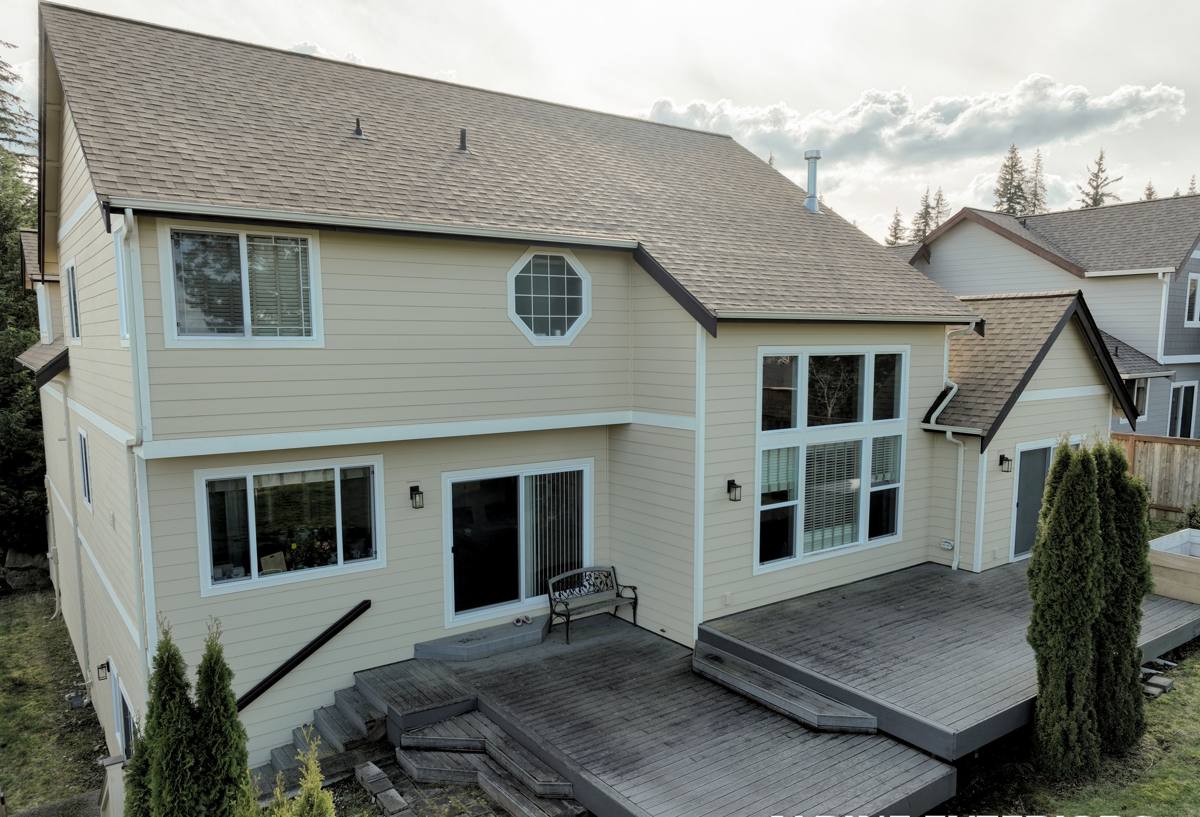
Signs Your Deck Needs Replacement, Not Just Repair
Not every tired-looking deck needs to come out. Sometimes a board swap, a fastener upgrade, or re-flashing a trouble spot solves the problem. But there's a point where patching stops making sense — either because the framing itself is compromised or because you'd be spending repair money on a structure that's past its useful life anyway. Here's what tips it toward replacement in our experience with homes in this area:
- Joists or beams that are soft, spongy, or visibly rotted when probed with a screwdriver
- A ledger board connection with staining, gaps, or soft wood around the flashing
- Railings or posts that flex or wobble under normal pressure
- Widespread cupping, splitting, or fastener pop-through across most of the decking, not just a few boards
- Footings that have shifted, heaved, or show cracking
- A deck more than 20-25 years old built to older code, especially around railing height and attachment
- Persistent moss or standing water in the same spots every year despite cleaning
If only one or two of these apply and the framing is sound, repair is often the smarter first move. When several apply, or the framing itself is in question, replacement usually costs less over time than chasing repairs on a structure that's already failing.
What a Correct Deck Replacement Involves
A deck replacement done right is mostly about what's underneath the decking — the parts you won't see again once it's finished. Skipping these is how a brand-new-looking deck ends up with the same problems five years later.
Ledger Flashing and Waterproofing
Where the deck ties into the house, the ledger board needs proper flashing that sheds water away from the structure, not just caulk over old fasteners. This is the step most likely to get shortcut on a lower-cost job, and it's the one that causes the most expensive damage down the road when it fails.
Footings and Framing Built for Wet Ground
Footings need to sit below the frost line and bear on solid, undisturbed soil — something worth checking on sloped or wooded lots, which describes a fair number of South Hill properties. Framing lumber should be rated for ground contact where it's close to grade or exposed to constant splashback, and joist spacing should match the decking material you're installing rather than whatever spacing the old deck happened to use.
Fasteners and Hardware That Won't Corrode
Salt-influenced air corrodes standard fasteners faster than most homeowners expect. Structural connectors, joist hangers, and screws should be rated for the treated lumber and coastal exposure they'll be living in — mismatched or undersized hardware is a quiet failure point that doesn't show up until years later.
Choosing the Right Decking Material
There's no single "right" decking material for every South Hill home — it depends on how much upkeep you want to do, your budget, and how the deck is used. Here's how the common options actually compare in this climate, without the marketing spin:
| Material | Moisture Handling | Maintenance | Typical Lifespan Here |
|---|---|---|---|
| Pressure-treated wood | Absorbs and releases moisture; prone to cupping and splintering without upkeep | Annual cleaning and re-sealing/staining recommended | 10-15 years before major work |
| Capped composite | Resists moisture absorption well; core still needs proper drainage below | Occasional washing; no staining or sealing | 20-25+ years, brand-dependent warranty |
| Cellular PVC | Essentially impervious to moisture absorption | Lowest upkeep of the three; occasional cleaning | 25+ years, brand-dependent warranty |
Wood costs less up front and is easy to repair board-by-board, but it demands real annual maintenance to hold up through a Whatcom County wet season — skip a year or two of sealing and moss and cupping catch up fast. Composite and PVC cost more initially but trade that for far less maintenance and better resistance to the moisture and moss this area throws at a deck year-round. Our standard is to walk you through the trade-offs honestly rather than push whatever has the best margin — the right call depends on how you use the deck and how much maintenance you actually want to keep up with.
Permits and Community Review
Deck replacement in Whatcom County typically requires a building permit, particularly when the structure is attached to the house, raised above a certain height, or when framing and footings are being replaced rather than just the decking surface. Requirements can vary depending on the scope of the project, so it's worth confirming before work starts rather than after. If your property in Sudden Valley falls under a homeowners' or community association, it's also worth checking whether there are design or material guidelines that apply to deck projects before you finalize plans — better to know upfront than to have to make changes later.
Our Deck Replacement Process
- On-site assessment — we check the ledger connection, framing, footings, and existing decking condition before recommending repair vs. full replacement.
- Written scope and estimate — you get a clear breakdown of what's being replaced, the materials involved, and the price, before any work begins.
- Permit handling — we take care of the permit application where one's required so you're not chasing paperwork.
- Tear-off and disposal — old decking, railings, and any compromised framing come out and get hauled away.
- Framing and ledger correction — footings, joists, and the ledger flashing get brought up to a standard that holds up to this climate, not just the old baseline.
- Decking, railing, and stair installation — installed to the manufacturer's specifications for your chosen material, including proper spacing for drainage and expansion.
- Final walkthrough — we go over the finished deck with you before calling the job done.
Cost Factors to Expect
Every deck is different, so we won't quote a number without seeing the site, but a few things consistently move the price:
- Size and shape of the deck, including any multi-level design
- Decking material choice — pressure-treated wood costs less upfront than composite or PVC
- Condition of the existing ledger, framing, and footings — hidden rot adds cost once it's exposed
- Railing style and stair complexity
- Site access and how far materials have to be carried from the driveway or road
- Permit requirements for the scope of work
Nationally, full deck replacement can range anywhere from the mid-teens to $45 or more per square foot installed depending on material and structural work — which is exactly why we give a written, itemized estimate instead of a ballpark over the phone.
Keeping Your New Deck Ahead of the Wet Season
A well-built deck still needs a little seasonal attention in this climate. A few habits go a long way:
- Sweep leaves and debris off the surface regularly in fall — trapped organic matter is what feeds moss growth
- Clean composite and PVC decking a couple times a year to prevent surface algae buildup
- Re-seal or stain wood decking on a regular schedule, not just when it looks faded
- Check that gaps between boards stay clear so water can drain instead of pooling
- Keep gutters and downspouts near the deck clear so runoff isn't dumping directly onto it
Why a Local South Hill Crew Matters
A deck built for a dry climate and a deck built for Sudden Valley's wet season aren't the same project, even if they look identical from the street. Flashing details, footing depth, fastener selection, and even how much slope you build into the decking for drainage all change based on what the structure actually has to handle here. A crew that already works this neighborhood has seen how local decks age — where the moss builds up first, which ledger details hold up and which don't, and what actually needs replacing versus what can be repaired. That's the difference between a deck that looks good for a season and one that holds up through years of Whatcom County weather.
If your deck is showing its age or you're just not sure whether it needs repair or full replacement, we're happy to take a look. Reach out for a free, no-pressure estimate using the form below.