 Sudden Valley
 What Happy Valley's Climate Does to a Deck
Homes in Happy Valley sit under a lot of tree cover, close enough to the water and the marine air moving in off the Salish Sea that a deck here works harder than a deck in a drier inland town. Three things stack up against any outdoor structure in this pocket of Whatcom County: salt-laden air that accelerates corrosion on fasteners and hardware, driving rain that comes in sideways during fall and winter storms and finds every gap, and a moss season that can run eight months out of the year in shaded yards. None of that is unique to one street or one lot — it's the baseline for this whole area, and it's why a deck built the way it might be built in a sunny, dry climate tends to disappoint homeowners here within a few seasons.
Wood decking shows this wear the fastest: graying, splintering, soft spots at the ledger, and a slick green film on the walking surface by late winter. Composite decking was developed specifically to resist most of that — but "composite" is not one product, and installing it correctly in a wet, shaded, moss-prone yard takes different choices than installing it in an open, sunny one.
Why Composite Is the Right Call Here
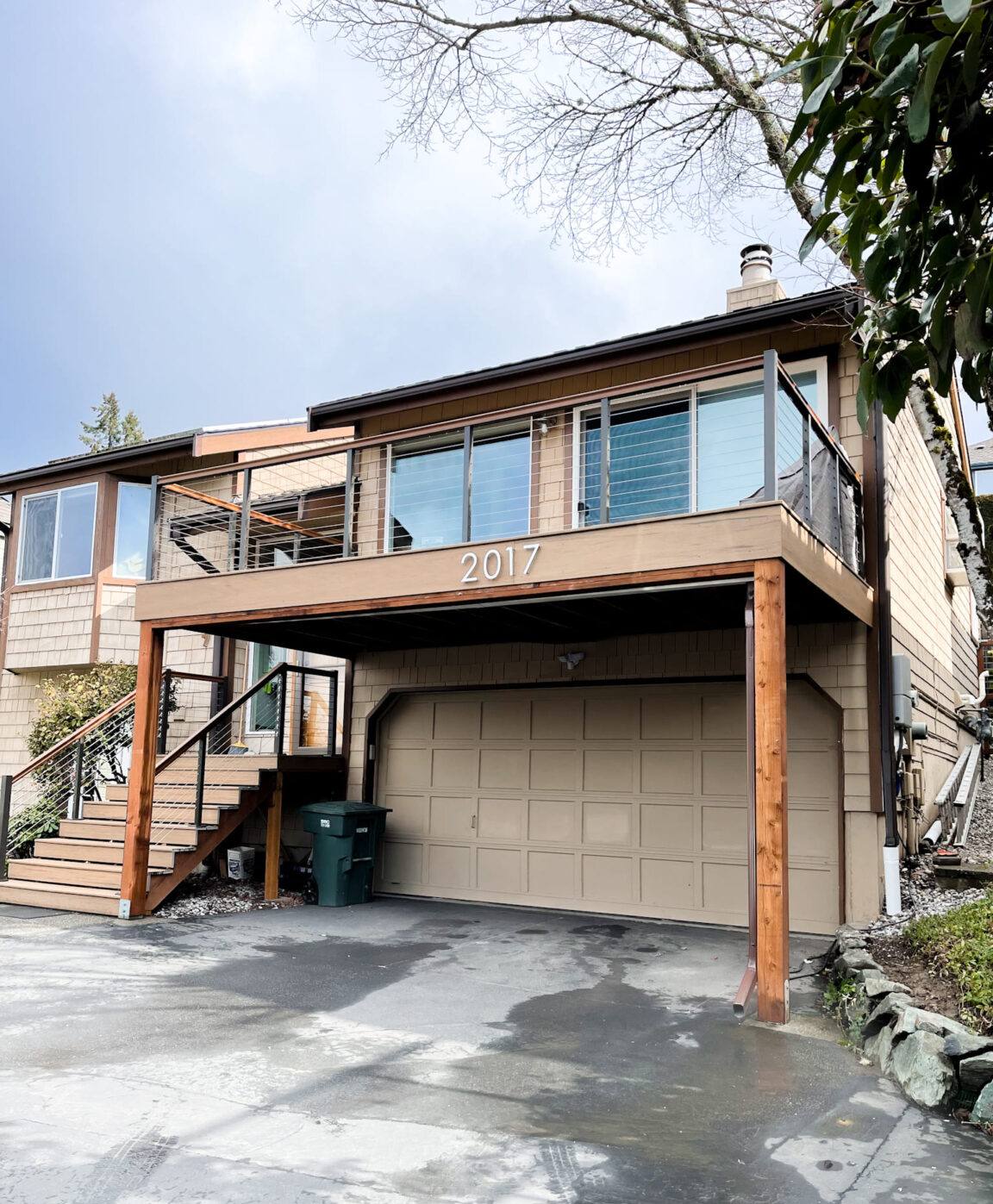
For most Happy Valley properties, composite decking is the more sensible long-term choice over wood. It won't rot, split, or need annual staining, and it holds up to repeated wet-dry cycling far better than lumber. That matters when a deck sits under a canopy that keeps it damp for days after a storm, or when it doesn't get direct sun until midafternoon in summer and barely at all in winter.
Where Composite Still Needs Help
Composite isn't maintenance-free, and we tell every homeowner that up front. It doesn't rot, but it can still grow surface algae and moss if it sits wet and shaded without airflow underneath or without occasional cleaning. The board itself resists moisture damage; what it can't do on its own is dry out a yard that doesn't get sun. That's a site condition, not a product flaw, and it's something we plan around rather than promise away.
What a Correct Composite Deck Build Involves
Framing and Ground Clearance
The substructure matters as much as the decking on top of it. In a shaded, damp yard, we pay close attention to ground clearance and airflow under the joists — a deck built low to wet soil with no cross-ventilation will trap moisture underneath, which speeds up moss growth on the boards above and can shorten the life of the framing itself, even when that framing is treated lumber. We also use joist tape over the framing to keep fasteners from sitting in standing moisture, which is a cheap step that prevents an expensive problem later.
The Ledger Connection — Where Deck Meets Siding
This is the part most decking-only companies treat as an afterthought, and it's the part we treat as the most important connection on the whole project. The ledger board — where the deck attaches to the house — has to be flashed correctly so water sheds away from the house and never gets behind the siding or into the rim joist. Get this wrong and you don't just risk the deck; you risk rot inside the wall the deck is bolted to, which is far more expensive to fix than any decking material. Because we work on siding and water management every day, we treat the ledger flashing with the same care we'd give any other siding penetration — proper flashing tape, correct lap order, and a gap that lets water drain instead of pool.
Choosing a Composite Board for This Climate
Not all composite decking is built the same way, and the differences matter more in a wet, mossy climate than they do somewhere dry. The table below is a general guide to the trade-offs — actual products and pricing vary by manufacturer and should be confirmed for your project.
| Board Type | Moisture Behavior | Maintenance | Typical Trade-Off |
|---|---|---|---|
| Capped composite | Protective shell resists moisture absorption and staining | Occasional wash to keep moss/algae off | Higher upfront cost than uncapped composite |
| Uncapped composite | More prone to surface moisture absorption over time | More frequent cleaning needed in shaded areas | Lower cost, shorter realistic lifespan here |
| PVC/cellular decking | Fully synthetic, doesn't absorb moisture | Low; wipes clean easily | Different look and feel underfoot than wood-composite blends |
For most Happy Valley yards with real shade and moisture exposure, we steer homeowners toward capped composite. The extra upfront cost buys real resistance to the staining and surface breakdown that uncapped boards show first in a climate like this.
Keeping Moss and Algae From Taking Over
Even the best composite board will grow a green film if it sits wet in the shade long enough — that's biology, not a defect. The goal of a correct install is to make moss and algae easy to manage rather than impossible to stop.
- Choose a board texture and color that shows less surface staining between cleanings
- Keep gaps between boards clear so water drains through instead of sitting on the surface
- Maintain airflow underneath the deck rather than skirting it in tight with no ventilation
- Trim back overhanging branches where possible to let more light and air reach the deck
- Rinse or lightly scrub the walking surface a couple of times a year, more often in heavy-shade spots
- Avoid pressure-washing at close range or high pressure, which can damage the board surface
None of this is heavy work, but it's easy to skip if nobody mentions it. We walk every homeowner through what their specific yard will need before we leave the job.
Our Process, Start to Finish
We start with a site visit, not a sales pitch. On a typical Happy Valley property that means looking at sun exposure, tree cover, existing drainage patterns, and the condition of the ledger area where the deck will attach to the house. From there:
- We assess the framing situation — repair or replace what's underneath before anything new goes on top
- We flash the ledger connection to the house correctly, matching it to your siding and water management
- We frame with proper ground clearance and ventilation for the site's shade and moisture level
- We install the composite decking per manufacturer spec, including fastening system and expansion gaps
- We walk the finished deck with you and go over the maintenance a board like yours actually needs
Any required permitting through Whatcom County is handled as part of the job — we don't leave that step for the homeowner to sort out.
Why Local Experience in Sudden Valley Matters
A crew that only builds decks in dry, open-lot subdivisions will make different assumptions than one that's used to Happy Valley's tree cover, lake-adjacent humidity, and older home layouts. We already know which framing details fail early in this specific kind of yard, which board finishes hide moss best under heavy shade, and how to flash a ledger correctly against the siding types common in Sudden Valley homes. That's not something you can fully substitute with a generic install crew driving in from out of the area for a one-off job — the callbacks we see on other companies' work around here are almost always tied to the same two things: a ledger that wasn't flashed properly, or framing that was never given a way to dry out.
What This Typically Costs
Composite decking costs more upfront than pressure-treated wood, but the gap narrows once you account for wood's ongoing staining, sealing, and repair needs. Exact pricing depends on deck size, framing condition, board selection, and site access — we give a firm number after seeing the property, not before.
| Cost Factor | Why It Matters Here |
|---|---|
| Framing condition | Damp, shaded lots often need more framing repair or upgraded ventilation |
| Board tier | Capped composite costs more but resists this climate's moisture and staining better |
| Ledger and flashing work | Correcting or upgrading flashing at the house connection adds labor but prevents costly rot later |
| Deck size and layout | Stairs, railings, and multiple levels add material and labor |
| Site access | Sloped or tree-lined lots common around Sudden Valley can affect equipment access and labor time |
If you're weighing a new composite deck or replacing a tired wood one, we're happy to take a look and give you a straightforward, no-pressure estimate — just fill out the form below and we'll set up a time to walk the site with you.