 Sudden Valley
 Deck Building in Columbia: What the Climate Demands
A deck in Columbia doesn't fail the way a deck fails in a dry climate. It doesn't crack from heat or bake out its finish in the sun. It fails from the bottom up and from the inside out — water that sits where it shouldn't, moss that holds moisture against wood or composite month after month, and salt-laden air off the water that speeds up corrosion on anything metal. Whatcom County gets a long stretch of gray, wet weather every year, and a deck that isn't built with that in mind will show its age fast: soft spots near the house, black streaks on the boards, fasteners bleeding rust, and railings that wobble because a post base has been sitting in standing water for a few winters.
None of that is inevitable. It's a function of how the deck was designed and built in the first place — the framing details, the material choices, the flashing, and the drainage. This page is about doing that correctly for a Columbia-area deck, not a generic build that happens to sit outside.
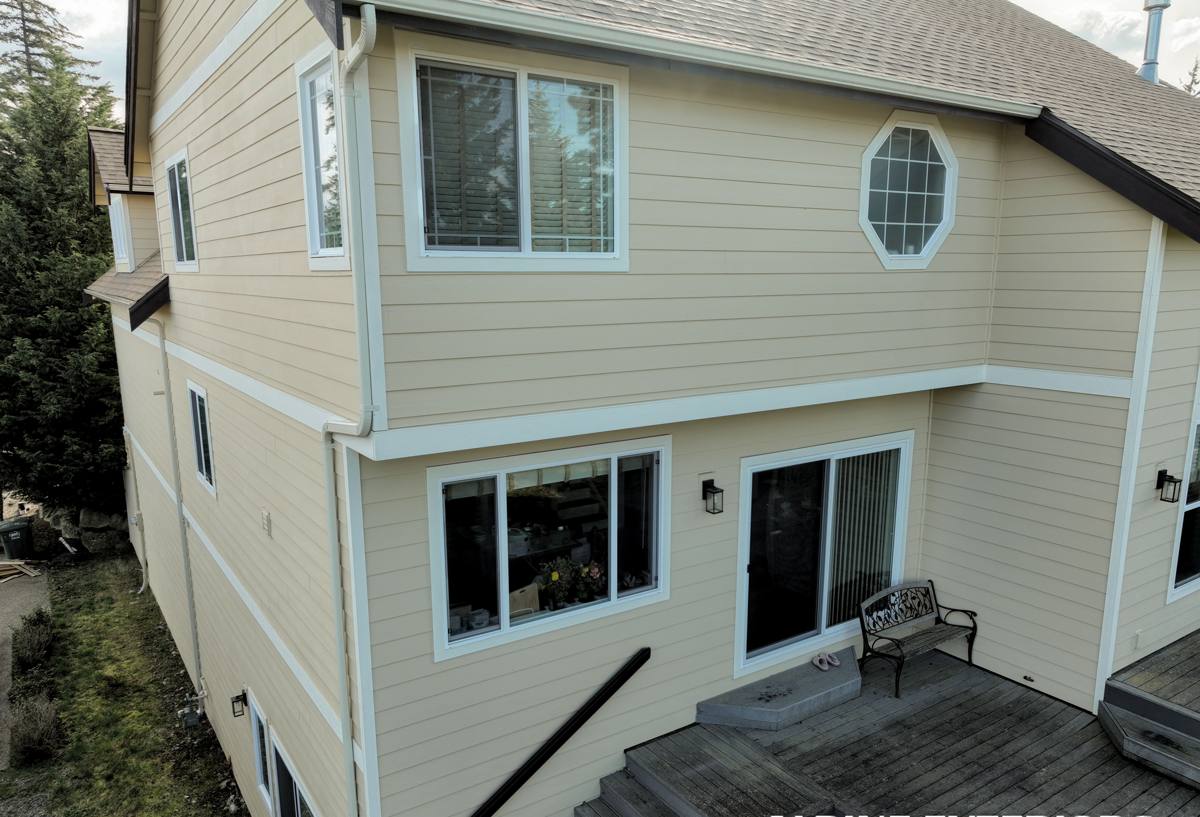
How Driving Rain, Salt Air, and Moss Actually Damage a Deck
Driving rain
Rain that comes in sideways off the water finds every gap in a deck's defenses — the ledger connection to the house, the tops of posts, the end grain of boards, and any spot where a fastener has backed out even slightly. Once water gets behind a ledger board or into end grain, it doesn't dry out quickly in our climate. It just sits there through the next several rain events.
Salt air
Moist, salt-carrying air accelerates corrosion on anything ferrous. Ordinary deck screws, joist hangers, and bolts that would last for years inland can start showing rust streaks and losing strength well ahead of schedule near the water. This is a hardware problem as much as a lumber problem, and it's one of the most common corners cut on decks that weren't built for this specific area.
Moss and organic buildup
Whatcom County's moss season runs long — shaded, north-facing, or low-airflow areas can stay damp for months at a stretch. Moss and algae hold water against the deck surface and framing below, keep boards from drying between rain events, and make the surface slick and dangerous underfoot. On wood decking, sustained moisture under moss is a direct path to rot. On composite, it's mostly a slip hazard and a maintenance headache, but it still points to a drainage or airflow problem worth fixing.
Choosing Decking Material for a Columbia Property
There's no single "best" decking material — there's a best material for a given budget, sun exposure, and how much upkeep the homeowner actually wants to do. Here's how the common options hold up under our conditions specifically.
| Material | How it handles our climate | Maintenance | Typical lifespan here |
|---|---|---|---|
| Pressure-treated fir/hem-fir | Good structural performance if kept sealed; end grain and fastener points are the weak spots | Re-seal or stain every 1-2 years | 15-20 years with upkeep |
| Cedar | Naturally rot- and insect-resistant, handles moisture well, but still needs a finish to fight graying and moss | Seal/stain every 2-3 years | 20-25 years with upkeep |
| Composite (capped) | Doesn't rot or absorb water like wood; still needs airflow underneath to avoid trapped moisture | Periodic wash-down, no sealing | 25-30+ years, manufacturer-warrantied |
| Uncapped/lower-grade composite | More prone to moisture absorption at cut edges and moss growth on the surface than capped composite | Regular cleaning to prevent staining | Shorter than capped composite |
We install both wood and composite decking depending on what a homeowner wants, but we're honest about trade-offs rather than pushing one product. Wood costs less up front and can be refinished indefinitely, but it demands a real maintenance habit in a climate that doesn't give boards much chance to dry out. Composite costs more up front and needs almost no sealing, but it still needs to be installed with proper gaps and ventilation underneath — a composite deck built without attention to airflow will still grow moss and hold moisture at the framing, it just won't rot the boards themselves.
Fasteners and hardware
Given the salt air, we don't treat hardware as an afterthought. Stainless steel or heavy hot-dip-galvanized fasteners, joist hangers, and structural screws cost more than standard coated hardware, but on a property near Lake Whatcom or exposed to marine-influenced weather, that difference shows up as the gap between hardware that's still tight in ten years and hardware that's rust-streaked and loosening in three or four.
The Structural Details That Actually Prevent Failures
Most deck problems we get called to look at aren't decking-surface problems — they're framing and flashing problems that took a few years to become visible. The details that matter most in this climate:
Ledger board flashing
Where the deck attaches to the house is the single most common failure point in the Pacific Northwest. Proper flashing — installed correctly under the house's water-resistive barrier, not just caulked over the top — keeps water from tracking behind the ledger and into the rim joist and wall framing. This is not a place to save money or time.
Post bases and footings
Posts that sit directly on or in concrete without a raised, ventilated base hold moisture against the end grain constantly. Elevated post bases that keep wood off wet concrete, combined with footings set below frost depth and sized for the actual load, are standard on our builds.
Joist protection and drainage
Unprotected joist tops absorb water through the countless screw holes drilled into them over a deck's life. Joist tape or an equivalent flashing membrane on top of every joist, combined with a slight slope away from the house and gaps sized to actually let water and debris pass through rather than collect, keeps the framing dry long after the surface has weathered.
Airflow underneath
A deck built low to the ground or against a slope with no cross-ventilation underneath will stay damp longer after every rain, which is exactly what feeds moss and rot. Where grading allows, we build in enough clearance and skirting gaps to let air actually move.
Our Process for a Columbia Deck Build
1. On-site assessment
We look at sun exposure, prevailing wind and rain direction, drainage around the house, existing structure if it's a replacement, and how the space will actually be used before recommending a layout or material.
2. Design and material selection
We walk through the material comparison honestly — budget, maintenance appetite, and how exposed the deck will be to weather — and settle on a design that fits the house and the site, not a one-size-fits-all layout.
3. Permitting
Deck projects in unincorporated Whatcom County typically require a building permit depending on size and height; we handle that process as part of the job so it isn't left to the homeowner to sort out.
4. Framing, flashing, and hardware
This is where the climate-specific details above get built in — ledger flashing, joist protection, corrosion-resistant hardware, and footings sized for the actual structure.
5. Decking, railings, and finish
Boards are installed with proper gapping for drainage and expansion, and wood decking is sealed before it sees a full season of rain, not left bare to weather first.
6. Final walkthrough
We go over maintenance expectations specific to the material installed — what a wood deck needs on a re-sealing schedule, what a composite deck needs for periodic cleaning — so there are no surprises the first wet season.
Living With a Long Moss Season
Even a well-built deck needs some seasonal attention here. The goal isn't to eliminate moss forever — in this climate that's not realistic on a shaded surface — it's to keep it from becoming a structural or safety problem.
- Sweep leaves and debris off the deck regularly through fall, especially in shaded corners where moss gets a foothold first
- Wash the surface at least once a year (more often on shaded or north-facing decks) to remove moss and algae before it embeds itself
- Check that gaps between boards are still clear and not packed with organic debris that traps moisture
- On wood decking, watch for soft spots, dark staining, or finish that's worn through — that's the signal to re-seal before the wet season sets in
- Check hardware and railing connections annually for rust streaking or looseness, particularly on decks with more direct exposure to wind off the water
- Confirm downspouts and grading near the deck are still directing water away, not toward, the footings
What a Columbia Deck Project Typically Costs
Exact pricing depends on size, material, height off the ground, and site access, but the factors below are what actually move the number:
| Cost factor | Why it matters here |
|---|---|
| Decking material (wood vs. composite) | Composite costs more upfront but less in maintenance over the deck's life in this climate |
| Height and railing requirements | Taller decks need engineered railings and stronger post connections |
| Ledger vs. freestanding structure | Freestanding decks need additional footings and framing since they can't rely on the house |
| Site access and slope | Sloped lots common around Sudden Valley often need taller posts, extra footings, or engineered foundations |
| Hardware grade | Stainless or heavy-galvanized fasteners cost more but hold up far better against salt-influenced air |
| Permit and engineering requirements | Larger or taller decks may require stamped engineering, which adds to the project cost |
We give straightforward written estimates that break these factors out so a homeowner can see where the money is going and where there's room to adjust.
Why a Crew That Already Works in Columbia Matters
A deck built to a generic spec sheet, without accounting for what this specific area's weather does over years, tends to look fine for the first season or two and then start showing problems right where the climate is hardest on it — the ledger connection, the fastener points, the shaded corners that never fully dry. A crew that's already built and maintained decks around Sudden Valley and the surrounding Whatcom County communities has seen which details actually matter here versus which ones are just spec-sheet boilerplate, and builds accordingly from the start rather than learning it from a callback.
That local experience also shows up in smaller, practical ways — knowing how the permitting process runs in this jurisdiction, understanding how a lot's slope or tree cover typically affects moss and drainage, and being available for follow-up if a homeowner has a maintenance question three winters into owning the deck.
If you're planning a new deck or replacing one that's showing its age, we'll come look at the site, talk through material options honestly, and put together a free, no-pressure estimate — no obligation, just a straight answer on what your project would actually involve.