 Sudden Valley
 Why Siding Installation in Barkley Is Its Own Kind of Job
Barkley homes sit close enough to Lake Whatcom and the broader Whatcom County weather pattern that siding here takes a different kind of beating than siding fifty miles inland. The combination of salt-tinged marine air moving in off the Sound, long stretches of driving rain in the fall and winter, and a moss season that can run half the year means the exterior of a house is almost never fully dry for more than a few days at a time. Siding that isn't installed with that reality in mind doesn't fail because the material was bad — it fails because water and organic growth found a way in through a joint, a fastener hole, or a piece of trim that was never properly flashed.
That's the lens we use on every Barkley siding installation: not "what looks good going up," but "what still looks good and performs correctly in year twelve." This page is specifically about installing siding on homes in and around Barkley — what the climate demands, what a correct installation actually involves, and how our process is built around both.
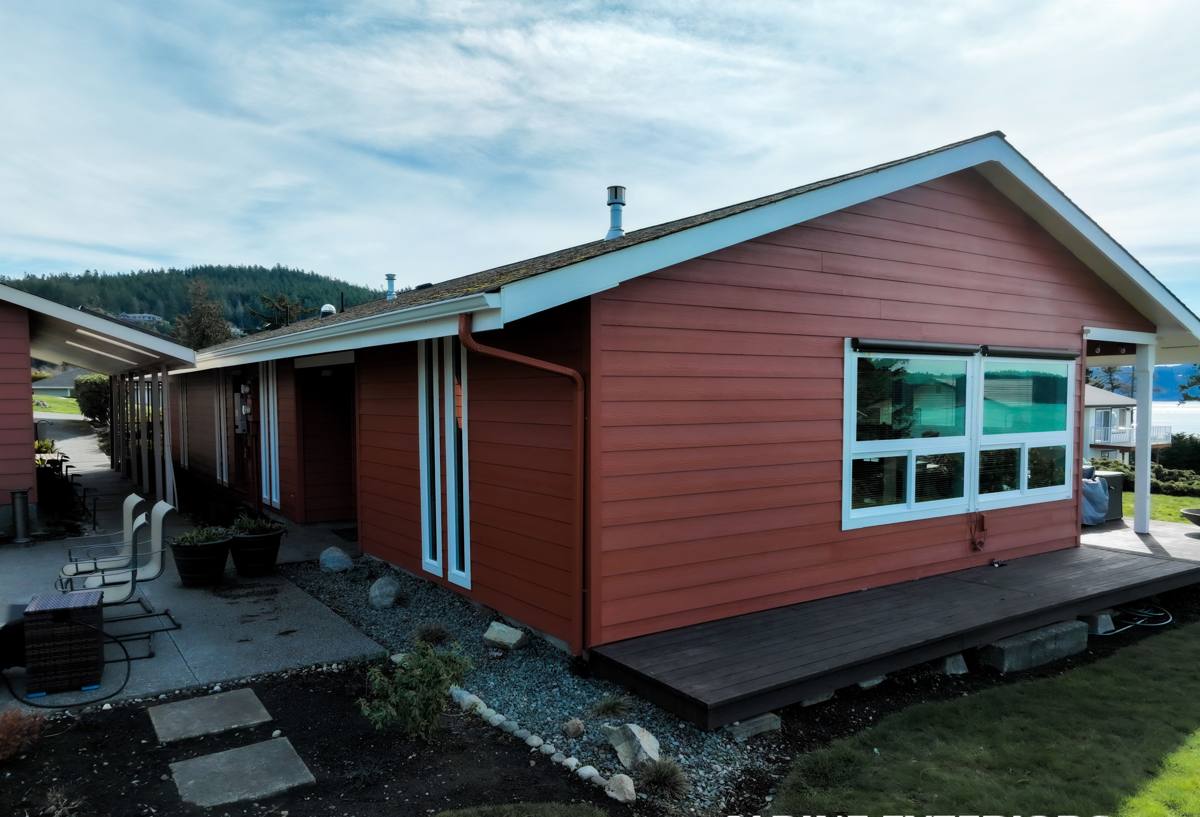
What This Climate Does to Siding Over Time
Moisture Load
Whatcom County gets a lot of rain, but it's the duration and the wind-driven angle of it that matters more than total volume. Rain that's pushed sideways against a wall finds horizontal laps, butt joints, and penetrations around windows and outlets that a straight-down rain never would. Over years, siding that wasn't installed with the right overlaps, gapping, and flashing details lets water track behind the cladding, where it can sit against sheathing far longer than anyone on the outside would ever guess.
Moss and Organic Growth
The shaded, damp conditions common around Barkley's tree cover are close to ideal for moss and algae. On siding, that growth isn't just cosmetic — moss holds moisture against the surface, and on the wrong substrate that constant dampness accelerates rot, paint failure, or swelling. Siding material and finish both play a role in how much moss actually takes hold and how easily it comes back off.
Salt-Influenced Air
Barkley isn't oceanfront, but the marine air pattern that moves through Whatcom County still carries a mild salt influence, especially in wind-driven weather. That's less of a factor for the siding panel itself and more of a factor for fasteners, flashing metal, and trim hardware — cheap or mismatched metal corrodes faster in this environment than it would in a dry inland climate.
Why We Install Only James Hardie Fiber Cement
We don't install vinyl, LP SmartSide, primed wood, cedar, or other fiber cement brands. That's a deliberate standard, not a sales pitch, and it's worth explaining briefly here because it directly affects what a Barkley installation looks like.
- Vinyl expands and contracts more than fiber cement in temperature swings, and in wind-driven rain its overlapping panel design gives water more opportunities to get behind it than a properly caulked and flashed fiber cement joint.
- LP SmartSide and other wood-based composites perform reasonably when kept dry, but they're more sensitive to sustained moisture exposure than fiber cement — a real concern given how long Barkley's siding stays damp in a normal winter.
- Cedar and primed spruce look great new but demand ongoing maintenance — recoating, caulking, moss treatment — that most homeowners underestimate, especially in a climate that gives wood so little chance to dry out between rain events.
James Hardie fiber cement is non-combustible, dimensionally stable in wet-dry cycles, and available in HZ5 formulations engineered for climates with exactly this kind of moisture exposure. The factory-applied ColorPlus finish resists fading and holds up to pressure washing far better than field-applied paint, which matters when moss removal is a normal part of home maintenance out here. It's not a maintenance-free product, but it's the one we're comfortable standing behind on homes that sit in this weather year-round.
What a Correct Installation Actually Involves
The siding material is maybe half the equation. The other half is installation detail, and this is where most long-term problems actually originate — including on homes that already have Hardie siding installed incorrectly by someone else.
Water Management Behind the Siding
Every wall needs a drainage plane — a water-resistive barrier and, ideally, a rainscreen gap — so that any moisture that does get past the siding has somewhere to go besides the sheathing. In a market like Barkley, skipping or shortcutting this layer is one of the most common causes of hidden rot behind siding that looks perfectly fine from the driveway.
Flashing at Every Penetration
Windows, doors, hose bibs, light fixtures, vents — every point where something interrupts the siding plane needs proper flashing integrated with the water-resistive barrier, not just caulk. Caulk is a maintenance item; flashing is a permanent water management detail. We treat caulk as the backup, never the primary defense.
Correct Fastening and Clearances
Hardie specifies fastener type, placement, and minimum clearances from grade, roofing, and decks for a reason — get those wrong and you create the exact entry points that a rainy, moss-prone climate will exploit. Panels also need to be gapped and caulked per Hardie's published specs, not just butted tight for a cleaner look.
Field Cuts and Painting
Any cut edge on a Hardie board exposes raw fiber cement that isn't factory-sealed. Left unpainted, those edges are a weak point for moisture intake. Every field cut on a proper installation gets sealed and touched up to match the ColorPlus finish before the panel goes up.
| Detail | Why It Matters in Barkley |
|---|---|
| Rainscreen / drainage gap | Lets wind-driven rain that gets behind the siding drain and dry instead of sitting against sheathing |
| Window and penetration flashing | Prevents the most common source of hidden water intrusion around openings |
| Fastener spacing and type | Corrosion-resistant, correctly placed fasteners hold up to marine-influenced air and repeated wet-dry cycles |
| Sealed field-cut edges | Stops moisture wicking into raw fiber cement exposed by on-site cuts |
| Clearance from grade and roofing | Keeps siding out of standing water and splash-back common in a high-rainfall area |
Signs a Barkley Home May Be Due for New Siding
- Persistent moss or algae staining that returns within a season of cleaning
- Soft spots, bubbling, or visible swelling, especially near the bottom courses or around windows
- Paint that's peeling or alligatoring faster than a normal repaint cycle would suggest
- Visible gaps, warping, or separation at butt joints and corners
- Rising energy bills that point to a compromised weather barrier, not just an aging furnace
- Siding installed more than 20-25 years ago in a material not rated for sustained wet exposure
Our Installation Process
- On-site assessment — we walk the exterior, check existing siding and sheathing condition, and note drainage, grading, and moisture patterns specific to the lot.
- Product and color selection — choosing the right Hardie line and ColorPlus color for the home's exposure and style.
- Tear-off and sheathing check — removing the old siding and inspecting what's underneath before anything new goes up; hidden rot gets addressed here, not covered over.
- Water-resistive barrier and flashing — installing the drainage plane and flashing every window, door, and penetration to spec.
- Hardie installation — panels, fasteners, gapping, and caulking per manufacturer specification, not shortcuts.
- Field-cut sealing and touch-up — every cut edge sealed and color-matched before final walk-through.
- Final walk-through — reviewing the finished work with the homeowner before we consider the job done.
Cost Factors for Barkley Siding Projects
Every home is different, but the same handful of factors drive most of the cost variation we see on Barkley projects.
| Factor | Effect on Cost |
|---|---|
| Home size and wall complexity | More corners, gables, and dormers mean more cutting, flashing, and labor time |
| Condition of existing sheathing | Rot discovered during tear-off adds repair scope before new siding can go on |
| Hardie product line chosen | Lap siding, panel systems, and trim/accent combinations price differently |
| Site access | Slopes, tight lots, or limited equipment access near Lake Whatcom terrain can add labor time |
| Color and trim detailing | Custom trim packages and accent colors add material and installation time |
We give exact numbers only after seeing the home — anyone quoting a firm price over the phone for a job like this is guessing.
Why Local Experience in Barkley Matters
A crew that already works in and around Sudden Valley and greater Whatcom County has seen how this specific climate behaves on real houses, not just in a manufacturer's install manual. That means knowing which elevations take the worst of the wind-driven rain, where moss tends to establish first, and which older installation shortcuts are already causing problems on homes nearby. It also means we're not learning the permitting and inspection process on your project — we already know it.
Get a Straight Answer for Your Home
If your Barkley home's siding is showing its age, or you're planning ahead rather than reacting to a problem, we're happy to take a look and give you a straightforward, no-pressure assessment of what your home actually needs. Use the form below to request a free estimate.