 Sudden Valley
 Why Decking in Barkley Has to Be Built Differently
Barkley sits inside the Sudden Valley area of Whatcom County, and like the rest of this part of the county, it gets a steady diet of marine-influenced weather moving in off the Sound and settling into the Lake Whatcom basin. That means salt-tinged air working into fasteners and hardware over time, driving rain that finds every gap in a poorly built substructure, and a moss season that can stretch from late fall well into spring. A deck that's installed the same way you'd install one in a dry inland climate is going to show problems here faster than it should — soft spots, discolored boards, slick surfaces, and hardware that rusts before its time.
Composite decking is a good answer to a lot of this, but only if it's installed with this climate in mind. The board itself resists rot in a way wood never will, but the board is only part of the system. The framing underneath, the flashing where the deck meets the house, and the fasteners holding it all together matter just as much — and those are the parts that get cut corners on decks that fail early.
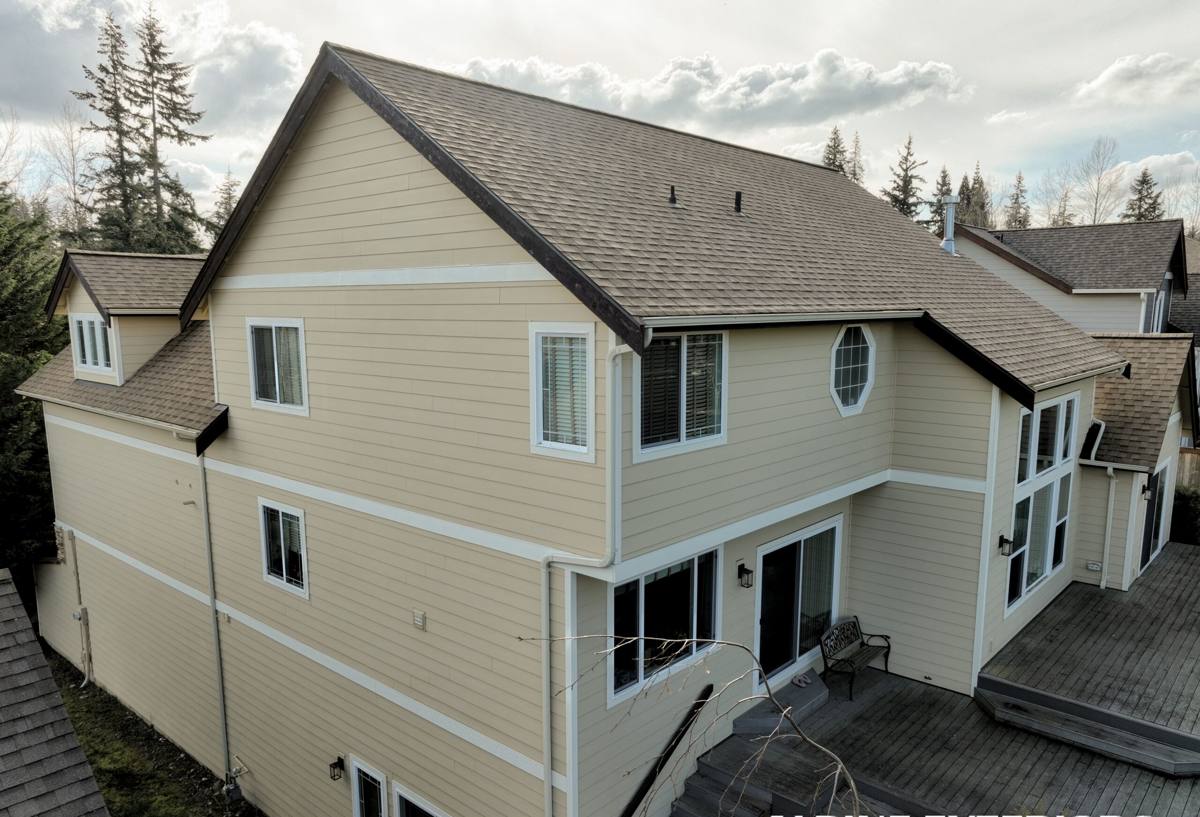
What "Correct" Composite Decking Actually Involves
A composite deck is only as good as what's underneath it. We treat the substructure as the part of the job that determines whether the deck lasts fifteen years or thirty, regardless of how good the boards look on day one.
Framing and Joist Protection
Composite boards are heavier than wood and behave differently under load and temperature swings, so joist spacing has to match the manufacturer's spec for the specific board profile — not a generic "16 inches on center and call it done" approach. We also wrap or tape the tops of joists with a waterproof membrane before boards go down. Untreated joists sitting under composite decking in a wet climate like this one will absorb moisture that has nowhere to evaporate quickly, since composite boards don't breathe the way wood does. That trapped moisture is what causes joist rot years down the road, hidden under a deck surface that still looks fine.
Ledger Board and House Connection
Where the deck attaches to the house is the single most common failure point on any deck, composite or otherwise. It needs proper flashing that sheds water away from the band joist and siding, not just lag bolts driven through unprotected wood. With the amount of driving rain this area gets, a ledger connection without correct flashing will let water track behind the siding and into the wall framing — a problem that's expensive to fix once it's been happening quietly for a few seasons.
Fasteners and Hardware
We use fasteners rated for the coastal-influenced air common to Whatcom County — stainless steel or coated hardware designed to resist the kind of corrosion that standard galvanized fasteners can't hold up against long-term near salt-influenced marine air. Hidden fastener clip systems, when used, also need to be the manufacturer-approved type for the specific board profile; mixing systems voids warranties and can cause boards to loosen or rattle.
Choosing the Right Composite Board for This Climate
Not all composite decking is built the same, and the differences matter more here than in a drier climate.
Capped vs. Uncapped Composite
Capped composite boards have a polymer shell wrapped around a wood-plastic composite core. That cap is what keeps moisture out of the core and resists staining, mold, and moss growth on the surface. Uncapped composite is generally cheaper but more porous, and in a climate with a long moss season, an uncapped board will show green growth and surface staining noticeably faster. For Barkley, we recommend capped composite as the standard, not the upgrade.
Surface Texture and Moss Resistance
Smooth, low-texture composite boards shed standing water faster and give moss and algae less to grip onto than deeply grooved or wood-grain-embossed surfaces. A slightly less dramatic wood-look texture is often the more practical choice on a deck that's shaded by trees or sits under a covered porch for part of the day, which is common on lots around Sudden Valley.
Color Considerations
Darker composite boards absorb more heat and can get uncomfortably hot on sunny days, but they also tend to show moss and organic staining less obviously between cleanings than very light boards. Mid-tone colors are usually the practical middle ground for this area.
Composite vs. Other Decking Materials
| Factor | Composite (Capped) | Pressure-Treated Wood | PVC |
|---|---|---|---|
| Moisture resistance | Strong, resists rot and swelling | Moderate, needs regular sealing | Very strong |
| Moss/algae resistance | Good, better with capped/smooth boards | Poor without regular treatment | Good |
| Maintenance | Periodic washing | Annual staining/sealing | Minimal washing |
| Upfront cost | Mid to upper-mid | Lowest | Highest |
| Typical lifespan | 25-30+ years | 10-15 years with upkeep | 25-30+ years |
| Feel underfoot | Closer to natural wood | Natural wood | Can feel more plastic |
We install all three of these materials and don't push one over another as a rule — a homeowner replacing an aging wood deck for lower upkeep is usually a good fit for composite, while some prefer PVC for a pool deck or a shaded, damp-prone spot where moisture resistance matters most. What we don't do is install any of them with shortcuts in the framing or flashing, because that's where decks in this climate actually fail.
Our Process on a Barkley Composite Decking Job
- On-site assessment: we look at the existing structure (if there is one), grade and drainage around the deck footprint, sun and shade exposure, and how the deck connects or will connect to the house.
- Structural evaluation: for a replacement, we check whether the existing framing, footings, and ledger connection can be reused or need to be rebuilt. Composite decking is heavier than wood, so old framing sized for a wood deck sometimes needs upgrading.
- Flashing and waterproofing: ledger flashing, joist tape, and any necessary drainage detailing get done before a single deck board is installed.
- Board installation: boards are laid per manufacturer spec for gapping, fastening, and expansion allowance — composite expands and contracts with temperature more than people expect.
- Railing and trim: fascia boards, railing systems, and stair details are finished to match the deck material and code requirements.
- Final walkthrough: we check fastener seating, board alignment, and drainage before calling the job done.
Living With a Composite Deck Through Moss Season
Composite decking cuts down maintenance significantly compared to wood, but "low maintenance" doesn't mean "no maintenance," especially with a moss season as long as this region's. A few basics keep a composite deck looking and performing the way it should:
- Rinse and sweep the deck surface regularly through fall and winter to keep wet leaves and debris from sitting in one spot
- Wash with a soft-bristle brush and a manufacturer-approved deck cleaner a couple times a year, more often in shaded areas prone to moss
- Avoid pressure washing at close range or high PSI — it can damage the cap layer on capped composite boards
- Keep gutters and downspouts near the deck clear so runoff isn't dumping extra water onto the deck surface
- Trim back overhanging branches where possible to cut down shade and debris that feed moss growth
- Check railing posts and stair connections annually for any looseness, especially after a hard winter
Mistakes We See on Decks That Weren't Built for This Climate
A lot of the deck problems we get called out to look at in the Sudden Valley area trace back to a handful of avoidable issues:
- No flashing, or inadequate flashing, at the ledger board connection to the house
- Joists installed without any moisture barrier under composite boards
- Standard galvanized fasteners used in an area where corrosion-resistant hardware would have held up longer
- Boards installed tight against each other with no expansion gap, leading to buckling
- Uncapped composite chosen for a heavily shaded, moss-prone yard where it stains quickly
- Decks built without enough slope or drainage consideration, leaving standing water after heavy rain
None of these are expensive fixes to avoid on the front end. They get expensive when they're discovered years later as rot, hardware failure, or a deck surface that's failed early.
Why It Matters to Hire a Crew That Already Works in Barkley
Sudden Valley's terrain and lot layouts aren't uniform — some homes sit on steep grades down toward the lake, some have heavy tree cover that keeps decks shaded and damp most of the year, and drainage patterns vary a lot from one street to the next. A crew that's worked decks in this specific area already knows what grading and drainage issues tend to show up, what kind of sun and shade exposure to expect on a given lot orientation, and how to plan a deck footprint and drainage path that won't dump water back toward the house foundation. That local familiarity shows up in fewer surprises during the job and a deck that's built for the actual conditions it's going to sit in, not a generic set of assumptions.
It also matters for permitting and code questions specific to Whatcom County, and for knowing which composite products and fastening systems have actually held up well in this climate versus which ones look good in a showroom but underperform once they're exposed to a real Pacific Northwest winter.
What a Composite Deck Project Typically Costs
| Factor | Impact on Cost |
|---|---|
| Deck size and shape | Larger footprints and multi-level or angled designs increase material and labor |
| Board tier (capped vs. uncapped) | Capped composite costs more upfront but resists staining and moss longer |
| Existing structure condition | Reusing sound framing costs less than a full tear-out and rebuild |
| Railing type | Composite or metal railing systems cost more than basic wood rail |
| Site access and grade | Steep or hard-to-access lots add labor time |
| Flashing and waterproofing detail | Proper ledger flashing and joist protection is a modest add that prevents major repair costs later |
Costs vary enough project to project that we'd rather walk your specific site than quote a number that doesn't mean much out of context. Broadly, composite decking runs higher upfront than pressure-treated wood but lower in lifetime cost once you factor out the annual staining and sealing that wood requires.
Get an Estimate for Your Barkley Deck
If you're planning a new composite deck or replacing one that's showing its age, we're glad to come take a look and walk you through what your specific lot and layout call for. There's no pressure and no obligation — just a straight assessment from a crew that works this area regularly. Fill out the form below to get started.