 Sudden Valley
 Why Storm Damage Looks Different on an Acme Roof
Acme sits in a rural, tree-lined stretch of Whatcom County, tucked into the valley terrain that funnels wind and rain differently than the open flatland around Bellingham or the shoreline itself. When a windstorm comes through, it doesn't hit every roof the same way — trees channel gusts, hillsides create pressure changes, and a roof that's shielded on one side can still take a beating on the other. Add in the marine air that rolls inland off the Sound, carrying salt and moisture even this far from the water, and you get a climate that's tough on roofing in ways that aren't always obvious from the ground.
Most storm damage here isn't dramatic. It's not always a tree through the roof or shingles peeled back in sheets. More often it's a handful of lifted or cracked shingles, a flashing seam that popped loose, or granules stripped off in a wind-driven downpour — damage that looks minor from the driveway but lets water in every time it rains after that. And in this part of the county, it rains a lot, for a long stretch of the year.
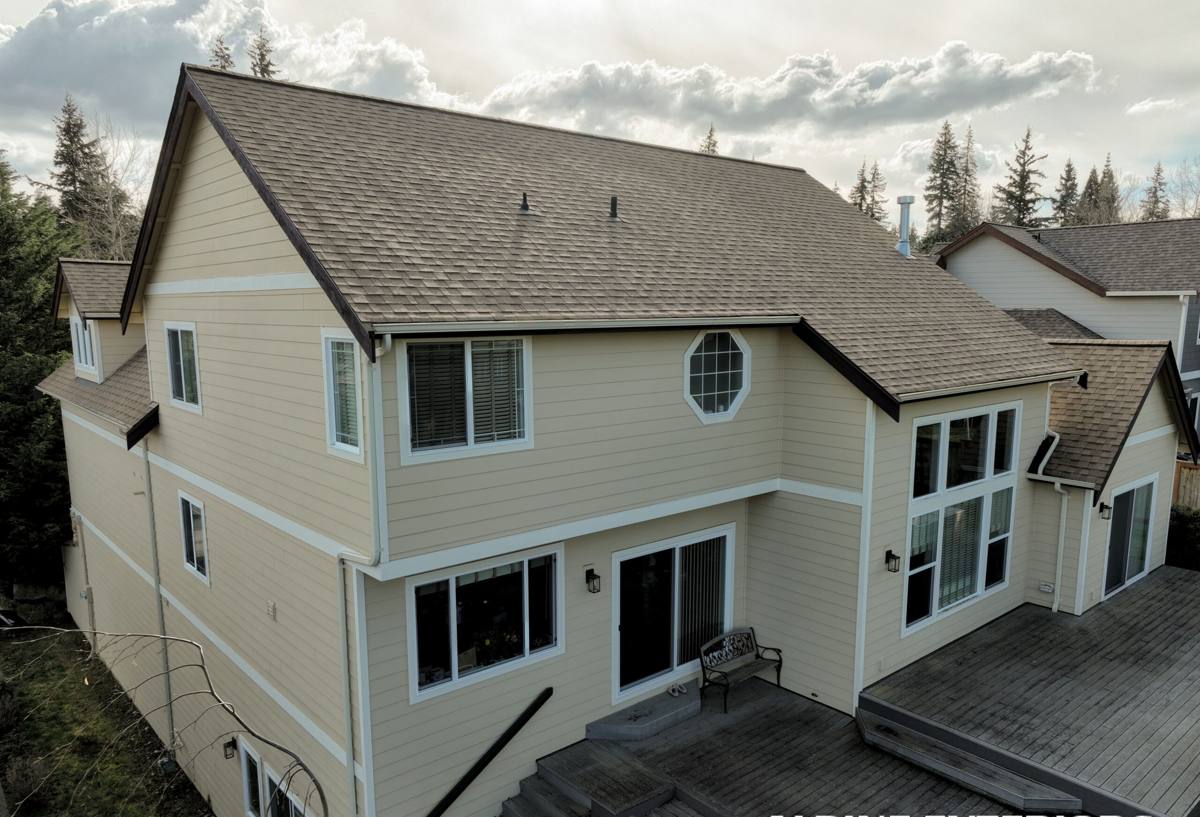
What Actually Counts as Storm Damage
Homeowners often think "storm damage" means visible destruction. In practice, it's a broader category, and knowing what to look for after a windstorm or heavy rain event matters more than most people realize.
- Shingles that are lifted, curled, or completely missing, especially on roof edges and ridges
- Cracked or torn shingles from wind flex, even if they're still nailed in place
- Flashing pulled loose around chimneys, vents, skylights, or where the roof meets a wall
- Granule loss showing up as bare, shiny patches or granules collecting in gutters
- Soft spots or sagging in the decking where water has already gotten underneath
- Debris impact damage from branches, needles, and cones driven by wind
- Moss mats that lifted during a storm, pulling shingle edges up with them
That last one is worth calling out specifically for this area. Moss doesn't just sit on a roof looking bad — it holds moisture against the shingle surface year-round, and during a windstorm, a thick moss mat can act like a sail, tearing at the shingle edges it's rooted into. A roof that's been neglected on moss control is more vulnerable to storm damage, not less.
What a Correct Storm Repair Actually Involves
A lot of storm repair work is done wrong not because the crew is dishonest, but because they're rushing to patch the visible problem and move to the next job. A correct repair starts with figuring out how far the water actually traveled, not just where the shingle is missing.
Inspection Comes Before Any Patch
Water doesn't always leak straight down from where it enters. It can travel along the decking or underlayment and show up as a stain several feet away, or not show up inside at all for months. A proper storm inspection checks the decking underneath damaged shingles, the condition of the underlayment, and whether nearby flashing was compromised by the same wind event — not just the spot that's obviously damaged.
Matching Materials, Not Just Covering the Gap
Patch repairs should match the existing shingle type, weight, and where possible, color and age so the repair doesn't stand out or perform differently than the surrounding roof. A mismatched patch is a common shortcut that leaves a roof with two different wear rates in the same area.
Sealing the Whole System, Not Just the Shingle
Flashing, underlayment, and ventilation all work together. Replacing a shingle over compromised flashing or wet decking just buys a little time before the same spot fails again.
How Our Process Works
For storm calls in Acme, we keep the process straightforward and honest about what's urgent versus what can wait.
- Initial call and triage — we ask what you're seeing (interior stains, missing shingles, debris) to gauge urgency before we're even on site.
- On-site inspection — we get on the roof, check the decking and flashing around any visible damage, and document what we find with photos.
- Temporary protection if needed — if there's an active leak or exposed decking, we tarp or seal it the same visit so water isn't getting in while a full repair is scheduled.
- Written scope and honest recommendation — we tell you plainly whether this is a spot repair, a section replacement, or something bigger, and why.
- The repair itself — matched materials, proper flashing work, and a check of surrounding areas that took the same storm exposure.
- Follow-up check — especially after a significant windstorm, we'll look at the repair again after the next heavy rain to confirm it held.
Repair or Replace? What Actually Decides It
Not every storm-damaged roof needs a full replacement, and not every "minor" repair should stay minor. Here's how we weigh it:
| Factor | Leans toward repair | Leans toward replacement |
|---|---|---|
| Age of roof | Under 12-15 years | Nearing or past expected lifespan for its material |
| Extent of damage | Isolated to one section or slope | Spread across multiple slopes or the whole roof |
| Decking condition | Dry, solid underneath | Soft, stained, or water-damaged in multiple spots |
| Moss/algae history | Recently cleaned, minimal buildup | Long-term moss damage already weakening shingles broadly |
| Prior repairs | First storm event on this roof | Multiple past patch jobs stacking up |
We'll tell you honestly which side of that table your roof falls on. A roof with one bad section and otherwise sound decking doesn't need to be torn off — but a roof that's had three storm patches in five years is telling you something the patches aren't fixing.
Storm Damage and Insurance Claims
Most homeowners' policies cover sudden storm damage — wind, falling debris, and similar events — though coverage details and deductibles vary by policy, so we're not going to promise what your insurer will or won't approve. What we can do is document the damage clearly with photos and a written scope at the time of inspection, which is the kind of record adjusters actually want to see. If you're filing a claim, having that documentation from the same visit as the initial damage assessment, rather than weeks later, tends to make the process smoother.
One thing worth knowing: not all storm damage is obvious enough to justify a claim, and we won't tell you it is just to inflate a job. If it's a genuinely minor repair, we'll say so.
Moss, Rain, and Why Storm Damage Compounds Here
Whatcom County's roofing challenges are cumulative, not one-off. A roof here deals with driving rain for months at a stretch, shaded, damp conditions that favor moss growth, and periodic windstorms that test whatever weaknesses that moss and moisture have already created. That's why storm repair in this area isn't just about fixing what broke — it's about checking whether the storm exposed a problem that was already building.
A shingle that lifted in 50 mph gusts might have lifted because the nailing was fine but the shingle underneath had already been softened by months of trapped moisture from moss. Fixing the lifted shingle without addressing the moss and moisture problem just sets up the same failure next storm season.
Why It Matters That We Already Work in Acme
Storm repair is time-sensitive in a way a lot of other exterior work isn't. A missing shingle after a windstorm can turn into a soaked attic in the next heavy rain, and Whatcom County doesn't go long between rain events for much of the year. A crew that's already familiar with Acme's roads, the terrain, and the way local storms tend to hit specific slopes can get out to a property faster and knows what to expect before climbing the ladder.
There's also a practical trust factor: a contractor who's done work in your area before has a reputation to protect with your actual neighbors, not just a review page. That tends to keep the work honest — no upselling a full tear-off when a repair will genuinely hold, and no underselling a repair that's really hiding a bigger problem.
Signs You Should Get a Storm Inspection Now
- You noticed shingles or debris in the yard after a windstorm
- There's a new stain on a ceiling or ceiling corner after heavy rain
- Gutters are suddenly full of granules after a storm
- You can see daylight or gaps in the attic where there shouldn't be
- A neighbor's roof took visible damage in the same storm
- It's been more than a couple years since your roof was last inspected
If any of these apply, it's worth getting eyes on the roof before the next rain rather than after.
If a recent storm has you wondering about your roof, we're happy to take a look and give you a straight answer — no pressure, no inflated scope. Fill out the form below for a free estimate and we'll get back to you.