 Sudden Valley
 Why Bellingham Roofs Wear Differently Than Roofs Inland
A roof in Bellingham does more work than a roof in a dry inland climate. Between the marine air coming off Bellingham Bay, the long stretch of wet months that define a Whatcom County winter, and the shade and humidity that let moss take hold on north-facing slopes, an asphalt shingle roof here is under near-constant low-grade stress. None of it is dramatic on its own. It's the combination, repeated year after year, that shortens the life of a roof that wasn't built with this climate in mind.
Salt Air and Slow Corrosion
Homes closer to the water pick up fine salt content in the air, and that salt settles on exposed metal — flashing, nail heads, vent stacks, gutter fasteners. It's a slow process, not an overnight failure, but over 15-20 years it accelerates corrosion on lower-grade metal components. This is why we pay attention to the fastener and flashing specification on a job near Bellingham Bay, not just the shingle itself. A roof is only as good as its weakest metal part.
Moss: More Than a Cosmetic Problem
Moss gets treated as an appearance issue, but on an asphalt shingle roof it's a moisture-retention problem. Moss holds water against the shingle surface long after the rain has stopped, keeps that section of roof damp for days at a time, and works its rhizoids into the granule layer. Over several seasons that granule loss exposes the asphalt mat underneath to UV and moisture it wasn't designed to face directly. Shaded, north-facing roof planes and anything under overhanging trees are the areas we watch closest on Bellingham homes.
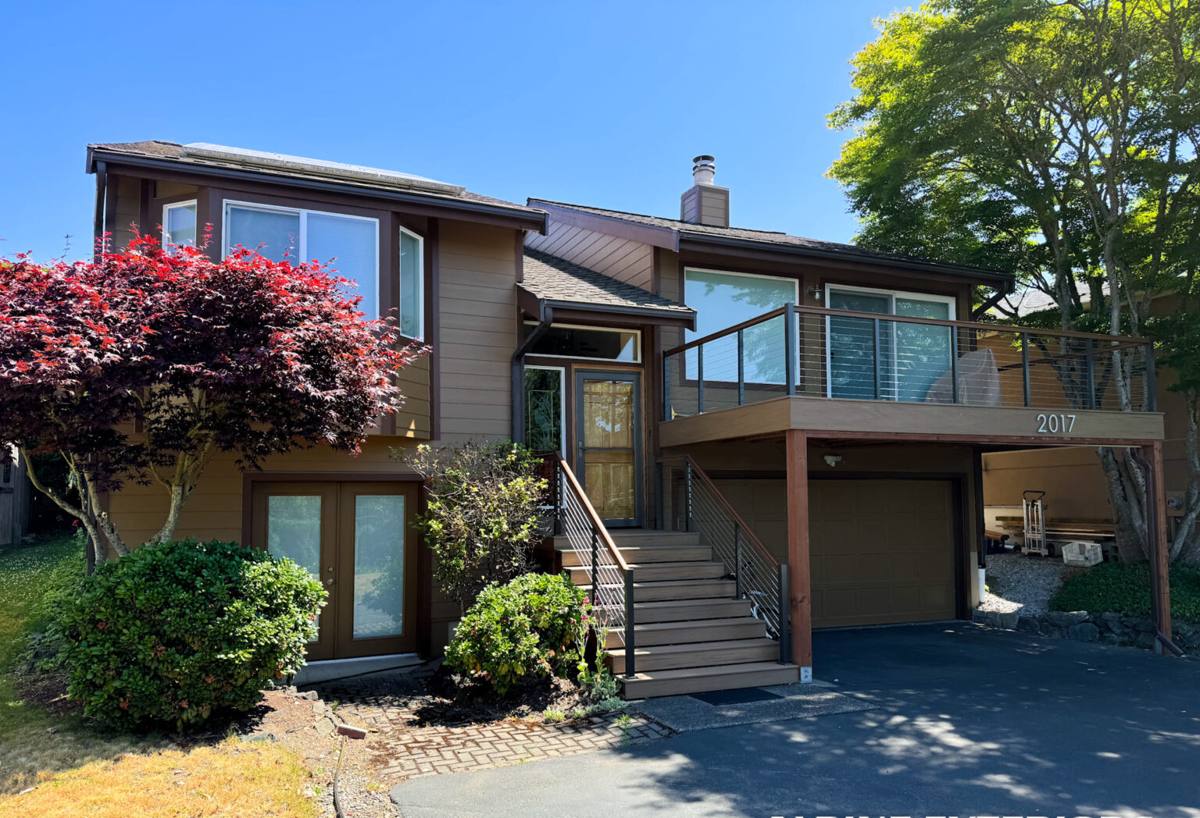
What a Correctly Built Shingle Roof Needs Here
A shingle roof that's going to hold up in this climate isn't just about which shingle you pick. The shingle is the visible layer, but three other things determine whether water actually stays out: the underlayment, the ventilation, and the flashing detail work. Get those three wrong and even a premium shingle will underperform.
Underlayment as the Real Weather Barrier
Shingles shed the majority of water, but wind-driven rain — which this area gets plenty of during winter storms — can push moisture up and under the shingle tabs. The underlayment beneath is what actually stops that water from reaching the decking. In a climate with this much sustained wet weather, we don't treat underlayment as a formality; it's a functional second layer of protection, and we spec it accordingly, with extra attention to eaves, valleys, and any low-slope transitions where standing water is more likely.
Ventilation and Moisture Management
A roof deck that can't breathe traps moisture from the living space below, and that trapped moisture condenses against the underside of the decking during cold, damp stretches. Over time that leads to sheathing that stays damp, which shortens the life of everything above it — shingles included. Balanced intake and exhaust ventilation matters as much in a wet coastal climate as it does in a cold one; it's just addressing a different failure mode.
Flashing Details That Actually Matter Here
Most shingle roof leaks don't come from the shingle field — they come from flashing: around chimneys, at sidewalls, in valleys, and around any roof penetration like a plumbing vent or skylight curb. In a region with this much sustained rainfall, marginal flashing work eventually fails. We treat flashing as its own trade within the job, not an afterthought tucked in during shingle installation.
Shingle Types and How They Perform Locally
Asphalt shingles aren't one product — there's a real range in construction quality, wind rating, and expected service life. For a Bellingham home, the right choice depends on exposure, roof pitch, tree cover, and budget. Here's how the common categories compare for this climate specifically.
| Shingle Type | Typical Lifespan Here | Wind Rating | Algae/Moss Resistance | Best Fit |
|---|---|---|---|---|
| 3-Tab (Standard) | 15-20 years | Lower | Standard granules only | Budget-focused, low-exposure roofs |
| Architectural / Dimensional | 25-30 years | Higher, better wind resistance | Often available with algae-resistant granules | Most Bellingham homes; best balance of cost and durability |
| Premium / Designer | 30+ years | Highest in the asphalt category | Algae-resistant granules standard on most lines | Steep-slope, highly visible, or high-exposure roofs |
For most homes in this area, we steer people toward an architectural shingle with algae-resistant (copper- or zinc-infused) granules. The upfront cost difference over a standard 3-tab is modest relative to the added years of service and the reduced moss/algae staining, which matters more here than in a drier climate.
A Note on Manufacturer Warranties
Warranty length is often used as a selling point, but the fine print matters more than the number. Most manufacturer warranties are prorated after the first several years, and nearly all of them require the installation to follow the manufacturer's published specification — nailing pattern, starter strip, ventilation minimums — to stay valid. We install to spec as a matter of standard practice, not just to protect the warranty on paper.
Our Installation Process
The steps below are the same core sequence on every asphalt shingle job we do, adjusted for the specifics of the roof in front of us.
- Inspection and scope. We look at the existing roof, the decking condition, ventilation setup, and any moss or moisture damage before quoting anything.
- Tear-off. Full removal of old roofing material down to the deck, with the deck inspected and any soft or delaminated sheathing replaced.
- Underlayment installation. Synthetic or felt underlayment installed with attention to eaves, valleys, and any low-slope sections, plus ice-and-water membrane in vulnerable areas.
- Flashing work. New flashing at chimneys, sidewalls, valleys, and penetrations rather than reusing old, potentially corroded pieces.
- Shingle installation. Installed to manufacturer nailing pattern and exposure spec, not a faster shortcut pattern.
- Ventilation check. Intake and exhaust balanced and functioning before the job is called complete.
- Cleanup and final walkthrough. Magnetic sweep for nails, debris removal, and a walkthrough so you know what was done and why.
Living With a Shingle Roof in This Climate
A well-installed roof still needs some basic upkeep in a place with this much rain and shade. None of this is complicated, but skipping it shortens the roof's life.
- Keep gutters clear so water isn't backing up under the lower courses of shingle during heavy rain.
- Have moss treated or gently removed before it spreads across a full roof plane — don't pressure wash it, which damages granules.
- Trim back tree limbs that keep a section of roof shaded and damp longer than the rest of the house.
- Schedule a walk-through inspection every couple of years, especially after a hard windstorm.
- Address small flashing or sealant issues right away — they're inexpensive to fix small and expensive once water gets under the decking.
Signs a Bellingham Roof Needs Attention Now
Most shingle roof failures give warning signs well before there's an active leak inside the house. Worth checking for:
- Granules collecting in gutters or at downspout outlets in noticeably larger amounts than before.
- Shingle edges curling or cupping, especially on south- or west-facing slopes with more sun exposure.
- Dark streaking or thick moss growth on shaded slopes, particularly north-facing planes.
- Soft spots underfoot on the roof deck, or sagging visible from the ground.
- Daylight visible through the attic roof boards, or damp insulation near the roofline.
- Flashing that looks lifted, cracked, or rusted around chimneys and vents.
Any one of these on its own isn't necessarily an emergency, but it's worth having looked at before the next wet season rather than after.
Why Local Experience Matters for This Work
Building for Whatcom County's Actual Weather
Roofing specs written for a dry climate don't automatically translate to Whatcom County. The wind-driven rain patterns off the water, the extended damp season, and the moss pressure from tree cover all push toward specific underlayment, ventilation, and flashing choices. A crew that works this area regularly makes those calls by default, not as an upsell.
Working Around a Real Weather Window
Tear-off and re-roofing needs a run of dry weather to do right — you don't want a deck exposed when a system rolls in off the coast. Scheduling around realistic weather windows here, and sequencing the work so the roof is never left more exposed than necessary, is a skill that comes from doing this locally, not from a general roofing playbook.
What Affects Cost and Timeline
Every roof is priced on its own specifics, but the factors that move the number are consistent. Broad ranges below are for orientation only — an accurate number comes from an actual look at your roof.
| Factor | Why It Matters |
|---|---|
| Roof size and number of planes | More square footage and more valleys/hips mean more material and labor time |
| Number of existing layers | Multiple tear-off layers add disposal cost and labor time |
| Deck condition | Rotted or soft sheathing found during tear-off adds material and time to replace |
| Roof pitch and access | Steeper roofs and difficult access require more safety setup and slow the work |
| Shingle class chosen | 3-tab, architectural, and premium lines carry different material costs |
| Ventilation or flashing upgrades | Bringing older ventilation or flashing up to current standards adds scope |
Most straightforward residential tear-offs and re-roofs run from a couple of days to about a week depending on size and weather. Anything involving significant deck repair or a complex roofline takes longer.
Getting an Estimate
If your roof is showing any of the wear signs above, or you're just trying to plan ahead before the next wet season, we're glad to come take a look. There's no pressure and no cost to get an honest read on where your roof actually stands — use the form below to request a free estimate.