 Sudden Valley
 What Alger's Climate Does to a Deck
Alger sits in that stretch of Northwest Washington where marine air off the Sound, frequent rain, and heavy tree canopy all combine against anything built outdoors. Decks here don't fail because the material is bad — they fail because they were built for a drier climate somewhere else. Composite decking can handle this environment very well, but only when it's installed with this specific climate in mind, not installed the same way a crew would build a deck in Spokane or Boise.
Three things do most of the damage to decks in this part of Whatcom and Skagit County:
- Salt-laden air — even a few miles inland, moisture carrying salt accelerates corrosion on fasteners, brackets, and any exposed metal hardware.
- Driving rain — wind-driven rain gets up under ledger boards, into end grain, and behind rim joists if flashing and drainage aren't done correctly.
- Long moss season — shaded, north-facing, or tree-covered decks in this area can stay damp for months at a stretch, which is exactly what moss and algae need to take hold on any decking surface, composite included.
None of that means composite decking is a bad fit for Alger — it's actually a strong fit, since it doesn't rot, splinter, or need annual staining the way wood does. It just means the build details matter more here than they would in a drier climate.
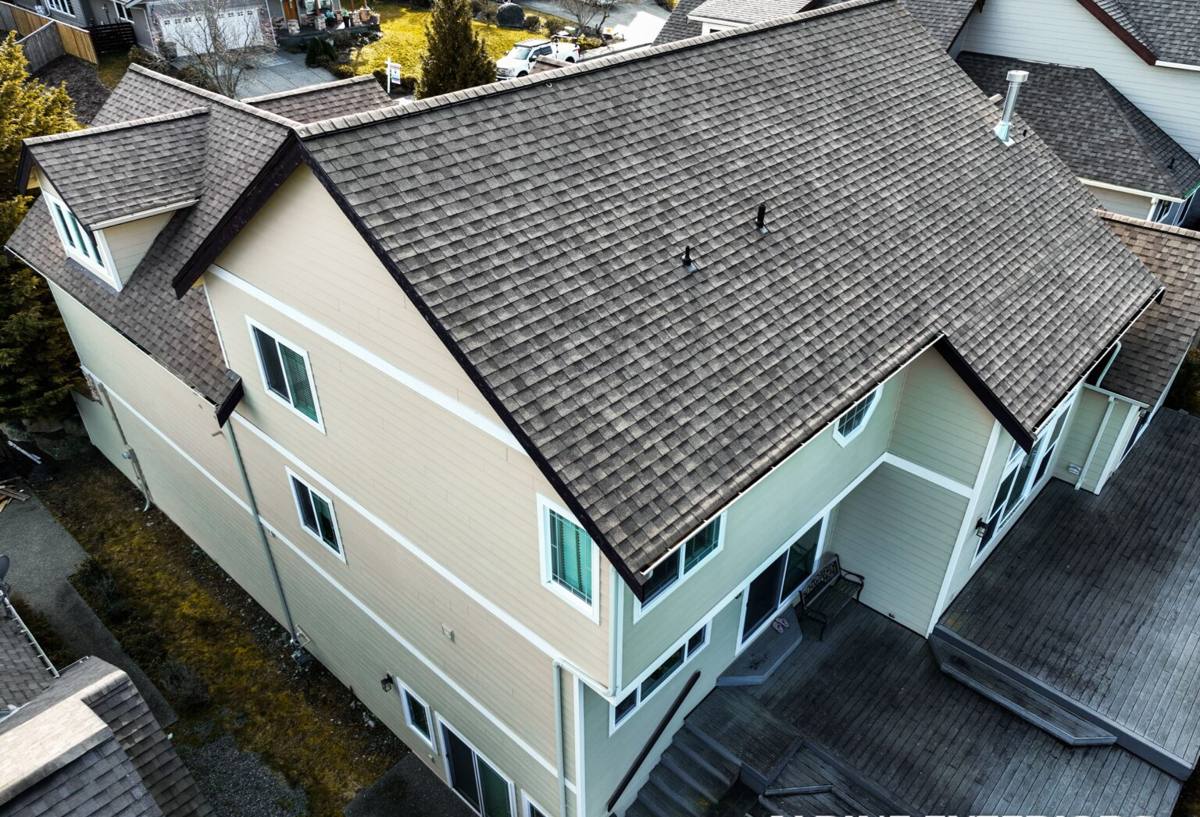
Where Composite Decks Actually Go Wrong Here
Trapped Moisture Under the Boards
Composite boards are more moisture-stable than wood, but the framing underneath them is usually still wood, and that's where problems start. Without a drainage plane, joist protection tape, and proper spacing, water sits against the framing long after the surface has dried, leading to hidden rot years before anyone notices from above.
Corroding Hardware
Standard hot-dip galvanized fasteners hold up fine in a lot of the country. In a coastal-influenced climate like Alger's, we've seen that grade of hardware start showing rust well before the decking itself shows any wear. Stainless or coated fasteners rated for coastal exposure cost more up front and are worth it on every job out here.
Moss and Algae on the Walking Surface
Even capped composite boards can grow a thin film of algae or moss in a shaded, damp spot if the deck doesn't get airflow and periodic cleaning. The board itself won't rot, but a slick, moss-covered composite deck is a safety issue, not just a cosmetic one.
Ledger Board Failures
The ledger board — where the deck attaches to the house — is the single most common failure point on any deck, composite or wood. In a climate with this much annual rainfall, a ledger without proper flashing and a drainage gap behind it will let water track into the house framing, not just the deck.
What Correct Installation Looks Like
A composite deck built to hold up in Alger's climate involves a handful of non-negotiable details:
- Pressure-treated framing rated for ground contact where applicable, with all cut ends re-treated on site.
- Joist tape over every joist top to seal fastener penetrations and shed water off the framing.
- Proper ledger flashing with a drainage gap and step flashing tied into the house's existing water management, not just caulked and bolted.
- Hidden fastener systems or coated screws rated for coastal/marine exposure — no standard interior-grade hardware.
- Board spacing set to the manufacturer's spec, adjusted slightly for our wetter climate to encourage airflow and drying between boards.
- Picture-frame or perimeter board detailing done with end caps or approved sealant on any exposed cut ends, since cut composite edges are more absorbent than the capped face.
- Under-deck drainage or grading so water sheds away from the house foundation, not just off the deck surface.
Skipping any one of these doesn't show up as a problem in year one. It shows up in year four or five, as soft framing, a stained ceiling below an elevated deck, or hardware that's rusted through.
Choosing the Right Composite Board
Not all composite decking is built the same way, and the differences matter more in a wet, shaded climate than they do in a dry one.
| Board Type | Moisture Behavior | Moss/Algae Resistance | Best Fit For |
|---|---|---|---|
| Fully capped composite | Best — cap layer sheds water on all sides | Good, especially with a textured cap | Shaded lots, decks near tree lines, most Alger properties |
| Capped on top only | Moderate — exposed underside/edges can absorb moisture | Fair — underside can stay damp longer | Sunnier, well-ventilated deck locations |
| Uncapped composite | Weakest — absorbs moisture through the full board | Poor in shaded, damp spots | We generally don't recommend this for Alger's climate |
| PVC/polymer decking | Excellent — no wood fiber to absorb water | Very good | Homeowners wanting the lowest possible maintenance |
We install fully capped composite and PVC/polymer boards on most Alger jobs because the maintenance burden and moisture behavior line up better with what this climate actually does to a deck over a decade, not just the first season.
Our Process on an Alger Deck
1. On-Site Assessment
We look at sun exposure, tree cover, prevailing wind and rain direction, existing framing condition (if it's a replacement), and how water currently moves around the foundation. This tells us where moss will be a recurring issue and where drainage needs the most attention.
2. Structural Check
For rebuilds, we inspect the ledger attachment, footings, and any existing framing before deciding what can be reused versus what needs to be rebuilt. Composite decking is only as good as what it's fastened to.
3. Framing and Waterproofing
This is where joist tape, ledger flashing, and coastal-rated hardware go in — the part of the job that's invisible once the decking is down but determines how long the whole structure lasts.
4. Decking Install
Boards go down with the manufacturer-specified fastening system, correct spacing, and attention to drainage at the perimeter and around any posts or railings.
5. Walkthrough
We go over basic care with the homeowner — what to expect from the board in year one versus year five, and simple upkeep that keeps moss and algae from getting a foothold.
What Drives Cost on This Type of Job
| Factor | Why It Matters in Alger |
|---|---|
| Deck size and shape | More cut edges and picture-framing increase both material and labor |
| Board tier (capped vs. PVC) | Higher-tier boards cost more up front but need less maintenance in a wet climate |
| Existing framing condition | Rot from a prior wood deck often means replacing joists or the ledger before decking goes on |
| Height and railing requirements | Elevated decks need more structural work and code-compliant guardrails |
| Site access and tree cover | Tight or heavily wooded lots slow down material staging and framing work |
| Drainage/grading needs | Sites with poor existing drainage need extra grading or under-deck systems |
We give a firm, itemized quote after seeing the site in person — anything else is a guess, and this climate punishes decks that were priced without accounting for drainage and hardware upgrades.
Living With a Composite Deck Here
Composite decking is genuinely low-maintenance compared to wood, but "low-maintenance" doesn't mean "no maintenance" in a climate with this much rain and shade. A simple seasonal routine keeps a composite deck looking and performing the way it should for its full service life.
- Sweep off leaves and debris regularly in fall — trapped organic matter is what feeds moss and algae growth.
- Rinse the surface a few times a year with plain water and a stiff (non-metal) bristle brush, more often on shaded sections.
- Check that gaps between boards stay clear of debris so water can drain through as designed.
- Inspect fasteners and any visible hardware annually for early rust, especially near the coast-facing side of the house.
- Trim back overhanging branches where practical to cut down on shade and falling debris.
- Confirm gutters and downspouts near the deck are directing water away, not onto the deck surface.
Permits, Code, and Local Considerations
Deck work in this area typically requires a building permit once you're past a certain size or height, and elevated decks have specific guardrail and stair requirements under the residential building code. Footing depth also matters more here than in drier regions, since frost depth and soil drainage both factor into how footings are sized and placed. We handle the permitting conversation as part of the estimate so there are no surprises once work starts, and we build to code as a baseline, not an upsell.
Why a Crew That Already Works in Alger Matters
General contractors from outside the area sometimes build decks the way they'd build them anywhere else — standard hardware, standard spacing, no extra attention to drainage. That approach can hold up fine in a lot of the country. It's a poor match for a climate with this much sustained moisture, salt-influenced air, and shade-driven moss growth. A crew that regularly works in and around Alger has already seen which details matter here: where moss shows up first on a given lot orientation, which hardware actually holds up near the coast, and how to flash a ledger board so it doesn't become a hidden leak point five years down the road. That familiarity shows up in fewer callbacks and a deck that still looks and performs well well past year one.
If you're planning a new composite deck or replacing a tired wood one in the Alger area, we're happy to come take a look and walk the site with you. There's no pressure and no obligation — just a straight assessment of what your property needs and an honest, itemized estimate. Use the form below to get started.