 Sudden Valley
 Why Decks Near Cordata and Sudden Valley Wear Out Faster Than You'd Think
Homes around Cordata and Sudden Valley sit in one of the wetter corners of Whatcom County, and decks take the brunt of it. Unlike siding, which is mostly vertical and sheds water quickly, a deck surface is horizontal — it catches rain, holds standing water in low spots, and stays damp long after a storm has passed. Add in a moss season that can stretch from October well into May, and you've got a structure that's almost always working against moisture rather than shedding it.
Many homes in this area also sit on sloped lots or above daylight basements, which means the deck's substructure — posts, beams, and footings — is often exposed underneath rather than tucked against a foundation wall. That underside rarely gets sun or airflow, so it dries slowly. Over years, that slow-drying cycle is what actually kills a deck, long before the surface boards look obviously bad.
The Local Factors That Matter Most
- Extended damp season means wood moisture content stays elevated for months at a time
- Moss and algae growth on decking and framing holds moisture against the wood surface
- Shaded, tree-lined lots common in this area slow drying time even further
- Coastal-influenced air adds a corrosion factor for older, non-coated fasteners and hardware
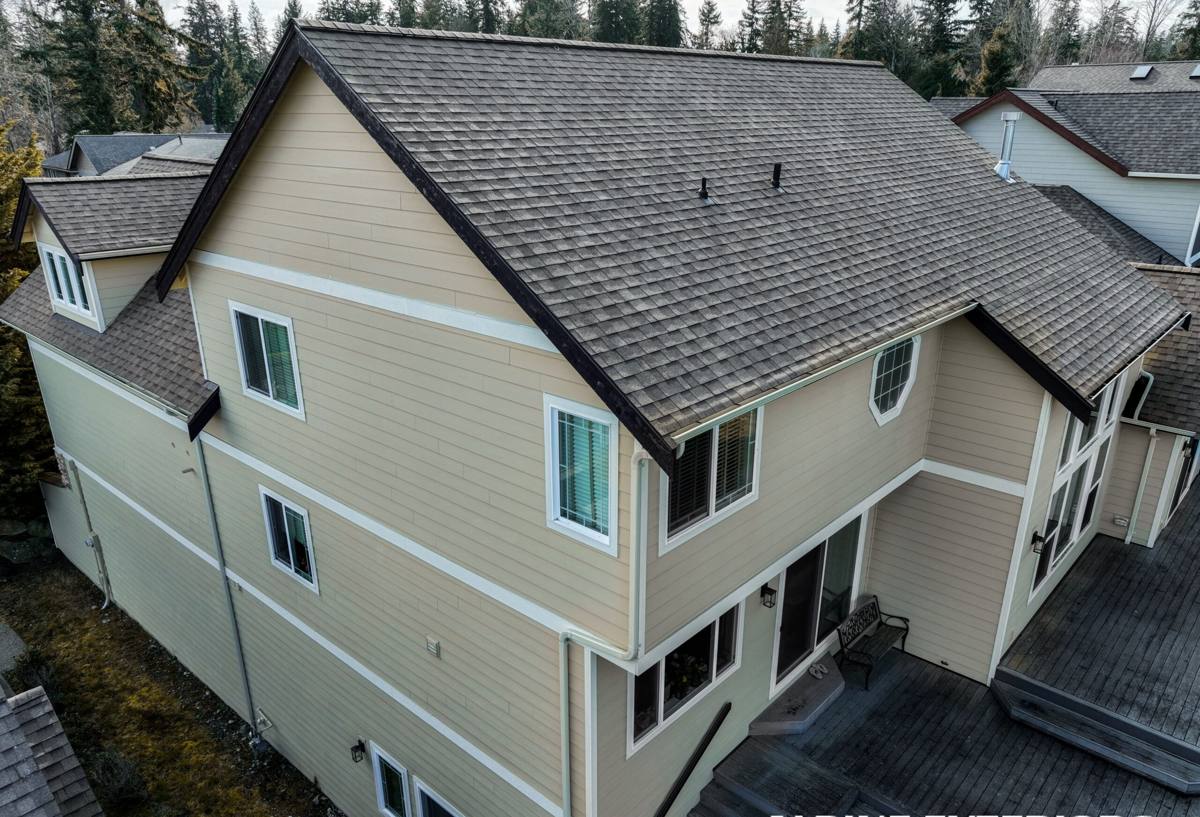
Signs a Deck Needs Replacement, Not Just Repair
Not every tired-looking deck needs a full teardown. But there's a point where patching boards or re-staining stops making sense — either because the structure underneath has failed, or because the cost of repeated repairs starts to rival the cost of doing it right once. Knowing the difference saves you money either way.
Repair Is Usually Enough When
- A handful of individual boards are cupped, splintering, or soft, but the framing underneath is solid
- Railings are loose but the posts themselves are sound
- Surface graying or moss buildup is cosmetic, with no soft spots when probed
Replacement Is the Honest Answer When
- A screwdriver sinks easily into joists, beams, or the ledger board — that's active rot, not surface weathering
- The deck feels springy or bouncy underfoot in multiple spots, not just one board
- Ledger board attachment to the house shows gaps, rust streaks, or water staining on the siding above it
- Post bases are sitting in standing water or buried in soil/mulch build-up
- The deck predates current fastener and flashing standards and was never properly flashed at the house connection
What a Correct Deck Replacement Actually Involves
A deck replacement done right isn't just new boards on old bones. The framing and the connection to the house matter more than the decking material sitting on top, because that's what determines whether the next deck lasts 10 years or 30.
The Structural Work That Often Gets Skipped
The single most common failure point we see on older decks in this climate is the ledger board — the piece that bolts the deck to the house — and the flashing (or lack of it) around that connection. Without proper flashing, rain runs behind the ledger and into the house framing, and by the time you see damage on the siding, the rot has usually been progressing for years. Any full replacement should include:
- Removing the old ledger and inspecting the house rim joist behind it for hidden rot
- Installing proper flashing at the ledger connection, lapped correctly with the siding or house wrap above it
- Checking and, where needed, replacing posts, beams, and joists — not just boards showing visible damage
- Confirming footings meet current frost depth and bearing requirements for the site
- Using corrosion-resistant, code-rated fasteners and structural connectors throughout
- Grading or adding drainage under the deck where water has been pooling against posts
Skipping any of this and simply re-decking over old framing is how a homeowner ends up paying for the same project twice within a decade.
Decking Material Options for This Climate
The right decking material for a Cordata-area home comes down to how much moisture and moss exposure the deck actually gets, and how much upkeep you're willing to do. There's no single "best" choice — there's a right trade-off for your site and your budget.
| Material | Moisture Behavior | Maintenance | Typical Lifespan |
|---|---|---|---|
| Pressure-treated wood | Resists rot when sealed regularly; absorbs water if coating lapses | Annual cleaning and re-sealing recommended in this climate | 10–15 years with upkeep |
| Cedar | Naturally decay-resistant but still needs sealing against constant damp | Periodic cleaning, staining every 2–3 years | 15–20 years with upkeep |
| Composite decking | Doesn't rot, but can hold surface moisture and grow moss/algae if not cleaned | Occasional washing; no staining or sealing | 20–30 years |
| PVC decking | Fully moisture-resistant surface; best resistance to moss staining | Lowest maintenance of the group | 25–30+ years |
Our standard here is straightforward: whatever material a homeowner picks, we won't install it over framing that hasn't been properly moisture-managed first. A premium composite or PVC deck surface on top of a poorly flashed, slowly rotting frame just hides the problem — it doesn't solve it.
Our Deck Replacement Process
Homeowners in the Cordata and Sudden Valley area generally go through the same sequence with us, whether the job is a small back deck or a large multi-level structure over a daylight basement.
Step by Step
- On-site evaluation — we check the ledger connection, probe framing and posts for soft spots, and look at drainage patterns under and around the deck.
- Honest scope discussion — we tell you plainly whether you need a repair, a partial rebuild, or a full replacement, and why.
- Permit handling — most deck replacements involving structural changes require a permit; we handle the application and inspection scheduling.
- Demolition and disposal — old decking, framing, and any rotted material removed and hauled off.
- Structural rebuild — footings, posts, beams, joists, and ledger flashing brought up to current code.
- Decking installation — your chosen material installed with proper spacing and fastening for drainage and expansion.
- Final walkthrough — we go over the finished deck with you, including any maintenance specific to the material you chose.
Permits and Code Considerations Locally
Deck work that involves new footings, structural framing changes, or height above a certain threshold typically requires a permit and inspection under Whatcom County or local jurisdiction building codes. This isn't paperwork for its own sake — it's what confirms your footings are sized correctly for the soil and your ledger connection is actually attached and flashed the way it should be. We handle this as part of the job rather than leaving it to the homeowner to sort out separately, and we won't skip it to save time, even on smaller decks.
What Deck Replacement Typically Costs
Exact pricing depends on deck size, height, substructure condition, and material choice, but here's how the major cost factors generally break down so you know what's driving the number on your estimate.
| Cost Factor | Why It Matters |
|---|---|
| Deck size and height | Larger and multi-level decks need more framing, more footings, and more labor hours |
| Substructure condition | Hidden rot in ledgers, beams, or posts adds repair scope not visible until demo begins |
| Decking material | Composite and PVC cost more upfront than wood but reduce long-term maintenance spend |
| Railing and stair complexity | Custom railings, multiple stair sets, or code-required guard heights add labor and material |
| Site access | Sloped lots or limited access around the house can add time for material handling and disposal |
As a rough range, a straightforward single-level deck replacement often lands in the low-to-mid five figures, with larger or multi-level decks over a daylight basement running higher. A written, itemized estimate after an on-site look is the only way to get a number that means anything for your specific deck.
Protecting Your New Deck Once It's Built
The maintenance a deck needs in this climate is different from what a deck needs in a drier region. A short, consistent routine goes a long way toward getting the full lifespan out of whatever material you chose.
- Sweep leaves and debris off the surface regularly, especially in fall — trapped organic material feeds moss and algae growth
- Rinse or wash the deck surface at least once a year to remove moss spores before they take hold
- Check the ledger flashing and the siding above it annually for staining or gaps
- Keep gutters and downspouts near the deck clear so runoff isn't dumping directly onto the structure
- Reseal wood decking on the manufacturer's recommended schedule — don't wait until it's visibly gray and dry
- Clear soil, mulch, or plantings that have built up against post bases
Why Local Experience on Deck Work Matters
A deck built for a drier climate, or built by a crew that mostly frames decks in dry conditions, doesn't automatically hold up here. The failure points we see most often in Cordata and Sudden Valley — ledger rot from missing flashing, post bases sitting in poorly drained soil, framing that never gets a chance to dry out under a shaded deck — are specific to this kind of long, wet, moss-prone climate. A crew that already works this area knows to check those spots first, not as an afterthought after something's already gone wrong.
We're a siding and exterior contractor based in the Sudden Valley area, and deck replacement is part of the same moisture-management work we do on the rest of the house — because a deck ledger and the siding around it are connected, literally and structurally. If your deck is showing its age, we're glad to come take an honest look, tell you what's actually going on underneath, and put together a free, no-pressure estimate for what it would take to do it right. The form below is the easiest way to get that started.